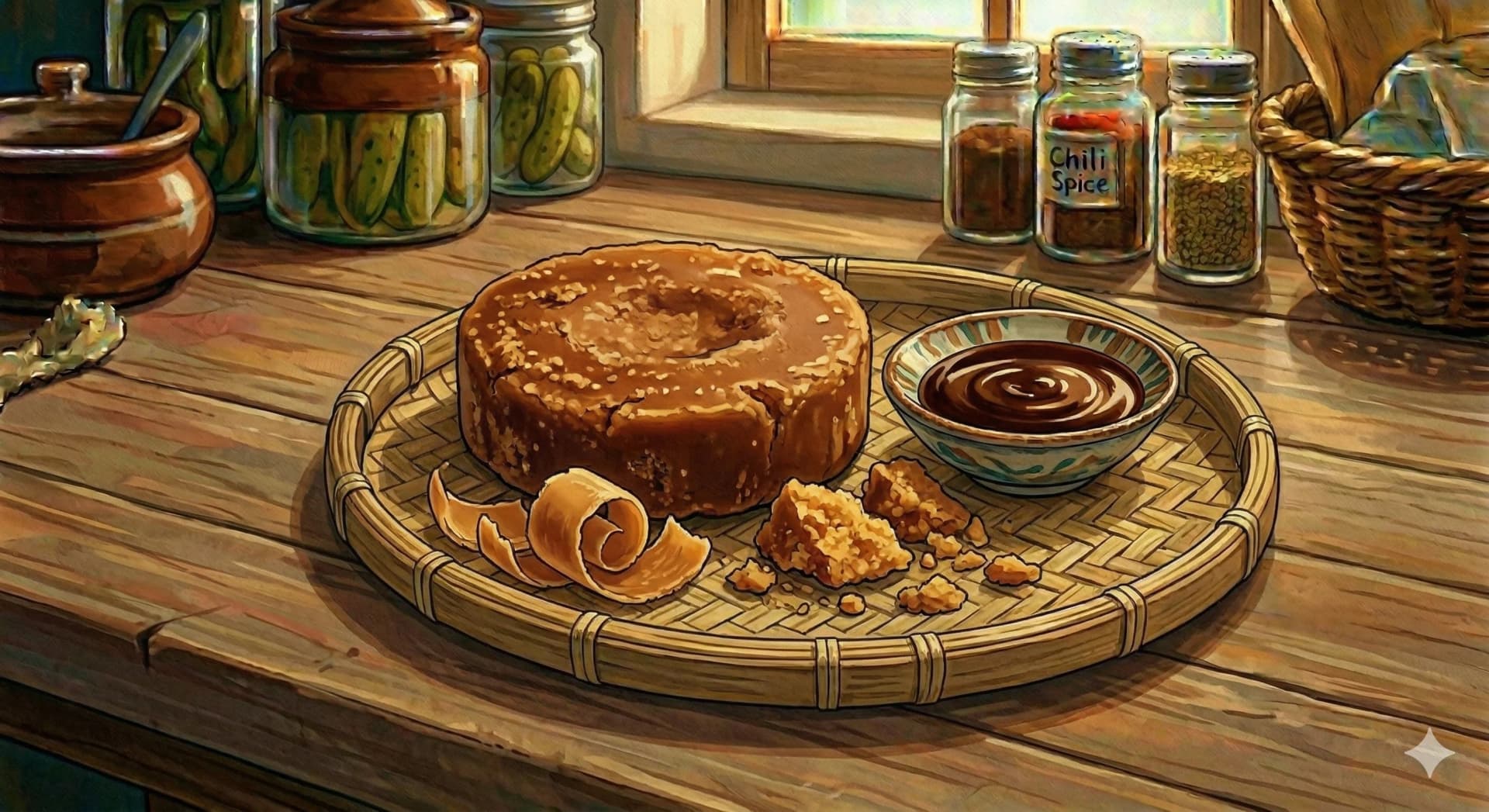
Palm Sugar
Also known as: Coconut Sugar, Gula Melaka, Gula Jawa, Nam Tan Pip
Palm sugar is produced from the sap of various palm species, most commonly the coconut palm (Cocos nucifera), the arenga palm (Arenga pinnata), and the palmyra palm (Borassus flabellifer). Skilled tappers climb the palms at dawn and dusk to collect sap that flows from cut flower buds into bamboo or clay containers. The sap is then boiled in open pans over wood fires until it reduces to a thick paste, poured into molds of bamboo, coconut shells, or clay to set, and sold in solid rounds, cylinders, or granulated form. The entire process is artisanal and time-intensive, which explains why good-quality palm sugar commands a premium over industrially produced alternatives.
Palm sugar is often conflated with jaggery in English-language recipes, but the two are distinct products from different source plants with different flavor profiles. Jaggery comes primarily from sugarcane or date palms, while palm sugar comes from coconut and other tree palms. The flavor difference is noticeable: palm sugar has a more floral, slightly smoky, coconut-forward character, while sugarcane jaggery tastes of molasses and raw cane. Gula melaka from Malaysia, widely considered the finest variety of palm sugar, has a particularly pronounced complexity, deep amber color, and an aromatic quality that evaporates somewhat when it is cooked and concentrates when it is not.
Palm sugar is also less sweet, gram for gram, than refined white sugar. Its sucrose content is lower, and the residual minerals, amino acids, and flavor compounds from the unreduced sap dilute its pure sweetness while adding character. This lower sweetness density, combined with its complex flavor, is precisely what makes it valuable in Southeast Asian cooking, where the goal is often not maximum sweetness but a nuanced background note that balances other forceful flavors.
Key facts at a glance:
- Artisanal product — from sap of coconut, arenga, and palmyra palms
- Distinct from jaggery — different source plants and flavor profiles
- Gula melaka — the Malaysian variety widely considered the finest
- Less sweet than refined sugar — lower sucrose, more complex flavor
- Glycemic index of ~35 — significantly lower than refined white sugar at 65-70
- Flavor balancer — used for nuanced sweetness, not maximum sweetness
Flavor Profile
Origin
Southeast Asia, South India, Sri Lanka
Traditional Medicine Perspectives
Ayurveda:
Palm sugar, particularly from the palmyra palm, is classified in Ayurvedic texts as lighter and more easily digested than sugarcane jaggery. Palmyra sugar (tala sarkara) is described as cooling, diuretic, and beneficial for Pitta conditions, making it preferable to the warming character of sugarcane jaggery in formulations intended to reduce internal heat. It is used in traditional preparations for respiratory conditions, digestive complaints, and as a general nourishing food. The sap itself, fresh and unboiled, is considered the most medicinal form.
Traditional Chinese Medicine:
In the traditional medicine systems of Southeast Asia, which draw on both Chinese and Ayurvedic influences, palm sap products are generally considered cooling and nutritive. Fresh toddy (unfermented palm sap) is used in folk medicine across the region for digestive complaints and as a general tonic. The reduced sugar retains some of these properties but in a more concentrated, less cooling form.
Modern Scientific Research
Palm sugar and coconut sugar have received attention in nutritional research primarily because of claims about their glycemic index. Studies have measured the glycemic index of coconut palm sugar at approximately 35, significantly lower than refined white sugar at 65 to 70, though other studies have produced higher readings, and the fiber content of palm sugar that might explain such an effect is quite low in most commercial products.
The glycemic index debate aside, palm sugar does retain minerals (potassium, zinc, iron, calcium) and a small amount of inulin (a prebiotic fiber) that are absent from refined sugar.
Arenga palm sugar (gula aren) has been found in some studies to contain higher phenolic concentrations than coconut palm sugar.
Polyphenols and antioxidant compounds have been identified in palm sap and palm sugar products, with concentrations varying by species, production method, and storage conditions. As with jaggery, the quantities at typical serving sizes are unlikely to be pharmacologically significant, but they do contribute to the flavor complexity of the sugar and represent a nutritional advantage over completely refined products.
Cultural History
Palm cultivation and palm sap collection represent one of the oldest agricultural traditions in Southeast Asia. Archaeological evidence from the Indonesian archipelago suggests that palm sap fermentation (producing toddy, the alcoholic precursor to palm sugar) predates rice cultivation in some regions. The decision to boil and reduce the sap rather than ferment it, producing sugar rather than alcohol, represents a technological shift whose precise date is difficult to establish but which was certainly widespread across Southeast Asia, South India, and Sri Lanka by the first millennium CE.
Regional varieties of palm sugar carry distinct cultural identities. Gula melaka, named for the city of Malacca on the Malay Peninsula and a historic center of spice trade, is the prestige variety of Malaysia and Singapore, used in the signature dessert cendol (shaved ice with pandan jelly, coconut milk, and gula melaka syrup) and in kuih (traditional Malay and Peranakan cakes and confections). Gula jawa from Java is darker, less refined, and more intensely flavored, integral to Indonesian cooking where it appears in rendang, sambal, and a wide range of sweets. In Thailand, nam tan pip (coconut palm sugar, sold in rounds) and nam tan tanode (palmyra sugar) flavor curries, pad thai, and nam jim dipping sauces.
In Tamil Nadu, Kerala, and Karnataka, palm sugar from the palmyra palm (karuppati in Tamil) is used in traditional temple offerings, folk medicine preparations, and sweets — the palmyra palm is culturally significant well beyond its sugar, sustaining coastal and agrarian communities for centuries.
Culinary Uses
In Southeast Asian cooking, palm sugar functions as a flavor balancer rather than simply a sweetener. In Thai cuisine, the canonical flavor triad of fish sauce (salt and umami), tamarind or lime (acid), and palm sugar (sweetness and depth) underlies the majority of curries, salads, and dipping sauces. The palm sugar in a Thai green curry paste or a nam prik pao roasted chili paste is not making the dish sweet; it is rounding out the saltiness and heat, providing a platform on which other flavors can stand without clashing.
In Indonesian and Malaysian cooking, palm sugar appears in sambal (where its sweetness balances chili heat), in rendang (where it deepens the caramelized coconut sauce), and in desserts like bubur sumsum and klepon (glutinous rice balls filled with palm sugar that melts into a warm, liquid center when bitten).
Its behavior in cooking is similar to jaggery: it dissolves more slowly than refined sugar and imparts color and flavor as it cooks.
For most applications it should be chopped, grated, or melted into a syrup before being added to a preparation.
Preparation Methods
To make a palm sugar syrup for desserts or drinks: cut or break 100 grams of palm sugar into rough pieces and place in a small saucepan with 100 ml of water. Heat over low to medium heat, stirring, until completely dissolved. For a richer, reduced syrup, continue cooking until the mixture coats the back of a spoon. Strain through a fine sieve. This syrup is the standard preparation for cendol, ice kachang, and other Southeast Asian desserts.
To use palm sugar in Thai curry: melt a small piece (approximately 10 to 15 grams) directly into the curry sauce rather than adding it as a hard chunk. Taste as you go: the goal is a background sweetness that rounds the sauce, not a perceptible sweet flavor. Add it toward the end of cooking when the sauce has already developed its full savory and acidic character, adjusting to balance.
Traditional Dishes
- Cendol
- Thai Green Curry
- Thai Red Curry
- Pad Thai
- Rendang
- Klepon
- Bubur Sumsum
- Kuih Dadar
- Payasam (palmyra)
- Karupatti Mittai
- Nam Jim Jaew
- Som Tum (green papaya salad)
- Pandan Cake
- Ondeh-ondeh
- Sambal
Comments
Share your thoughts on this ingredient.
Sign in to comment0 Comments