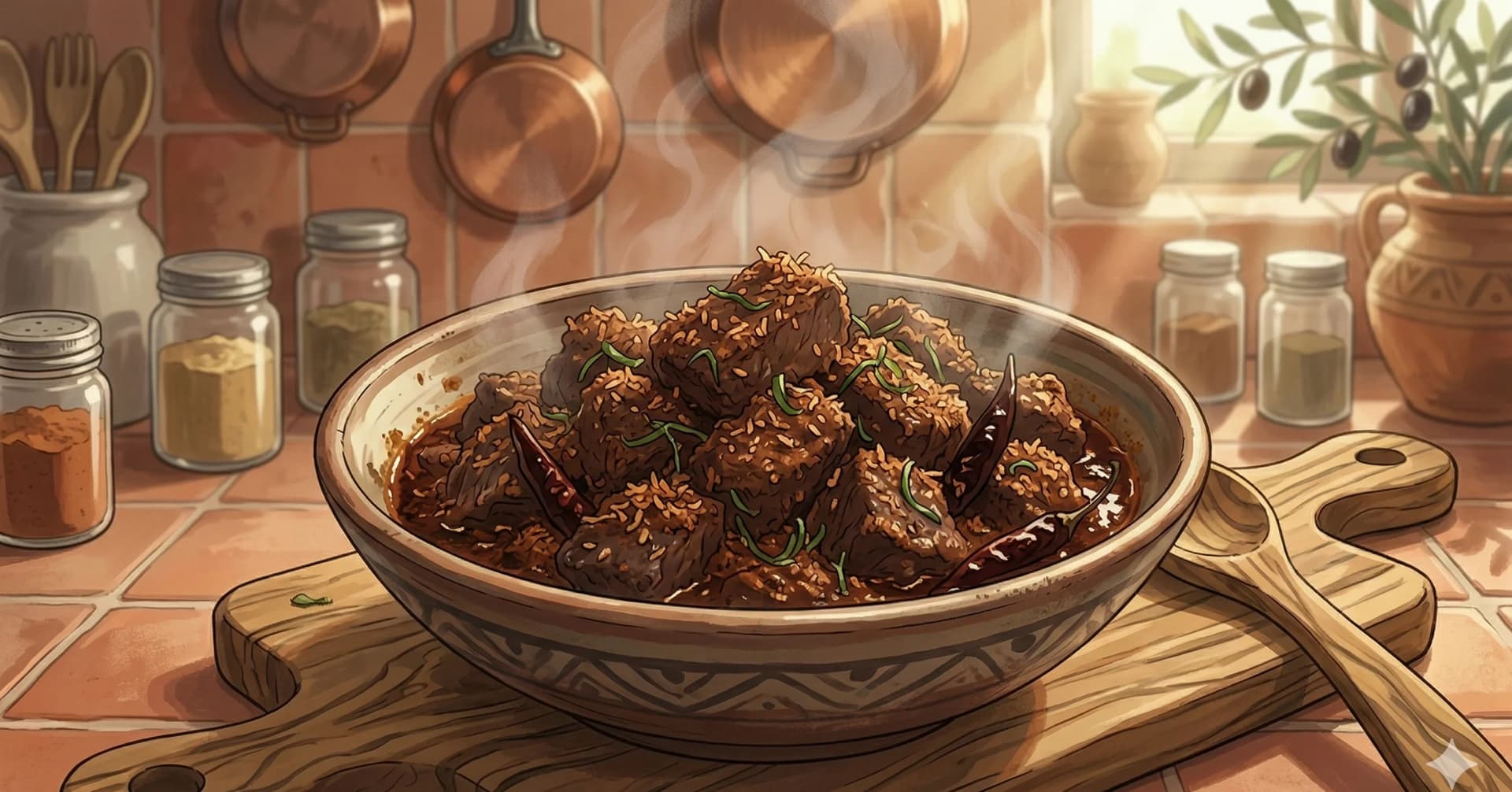
Malaysian Cuisine
Beef Rendang (Rendang Daging)
A deeply spiced, dry-braised coconut beef stew from the Minangkabau tradition, slow-cooked until the meat is tender and lacquered in a dark, fragrant paste of chilies, lemongrass, galangal, and toasted coconut
Rendang is not a curry. That distinction matters. Where a curry aims for a loose, saucy consistency that pools around rice, rendang goes in the opposite direction. The coconut milk reduces completely. The spice paste caramelizes around the meat. What remains is beef that has absorbed hours of slow simmering and emerged dark, deeply fragrant, and coated in a concentrated layer of chili, lemongrass, and toasted coconut. It is one of the driest braises in Southeast Asian cooking, and also one of the most flavorful.
The dish originates with the Minangkabau people of West Sumatra, where it has been prepared for ceremonial occasions and long journeys for centuries. The thorough cooking and near-total evaporation of moisture give rendang a remarkably long shelf life, which once made it invaluable as a preserved food for travel. When the Minangkabau migrated south to the Malay Peninsula during the Melaka Sultanate era, rendang came with them, and it is now as central to Malaysian cooking as it is to Indonesian.
The secret ingredient in a well-made rendang is kerisik, toasted grated coconut that has been pounded to a rough paste. It adds a nutty richness and a slight graininess to the sauce that coconut milk alone cannot provide. Making it takes five minutes in a dry wok, and the difference it makes is significant. The other key is patience. Rendang cannot be rushed. The slow reduction of coconut milk over low heat is what transforms the sauce from a pale, thin liquid into the dark, clingy coating that defines the finished dish.
If you enjoy this style of slow, aromatic braising, you will find a similar approach in bo kho, a Vietnamese beef stew that shares the use of lemongrass and star anise, and in massaman curry, a Thai braise that draws from the same South and Southeast Asian spice trade routes.
At a Glance
Yield
4 servings
Prep
30 minutes
Cook
2 hours
Total
2 hours 30 minutes
Difficulty
Medium
Ingredients
Spice Paste Ingredients
- 10to 12 dried red chilies, soaked in warm water for 15 minutes and seeded (adjust to taste)
- 2¾ ozshallots (about 5 small), roughly chopped
- ¼ cupgarlic (about 5 cloves), roughly chopped
- 3lemongrass stalks, white part only, thinly sliced
- ½ ozgalangal (about 2½ cm), roughly chopped
- 2½ tbspfresh ginger (about 2½ cm), roughly chopped
- 2 tbspcooking oil (for blending, if needed)
Braise Ingredients
- 1½ lbboneless beef short ribs, cut into 4 cm cubes
- ¼ cupcooking oil (coconut or neutral vegetable oil)
- 1cinnamon stick, about 5 cm
- 3 wholecloves
- 3star anise
- 3green cardamom pods, lightly crushed
- 1lemongrass stalk, bottom 10 cm only, lightly smashed with the back of a knife
- 1¾ cupfull-fat coconut milk
- 1 cupwater
- 2 tbsptamarind water (from 15 g tamarind pulp soaked in warm water, seeds discarded)
To Finish
- 6kaffir lime leaves, central rib removed, very finely sliced into thin ribbons
- 1½ ozkerisik (toasted grated coconut, see method step 1)
- 1¼ tbsppalm sugar or light brown sugar
- —Salt, to taste
To Serve
- —Steamed jasmine rice or [nasi lemak](/recipes/nasi-lemak)
Method
- 1
Prepare the kerisik first. Place 60 g desiccated or freshly grated coconut in a dry wok or skillet over medium-low heat. Stir constantly with a wooden spatula, scraping the bottom as you go. The coconut will begin to release its oil and turn from white to pale gold over about 3 to 4 minutes, then deepen to a rich, uniform brown over another 2 to 3 minutes. The kitchen will smell warm and toasty, like roasted nuts. Remove from the heat immediately when the color is an even golden brown, as it will continue to darken off the heat. Transfer to a mortar and pound to a coarse, oily paste. You need about 45 g of the finished kerisik. Set aside.
- 2
Drain the soaked dried chilies and squeeze out excess water. Place them in a food processor or blender along with the shallots, garlic, lemongrass, galangal, and ginger. Blend to a fine paste, scraping down the sides as needed. Add a splash of cooking oil or a tablespoon of water if the mixture is too dry to come together. The finished paste should be smooth with no large pieces remaining.
- 3
Heat the 60 ml of cooking oil in a heavy-bottomed pot or Dutch oven over medium heat until it shimmers. Add the cinnamon stick, cloves, star anise, and cardamom pods. Stir them in the oil for about 30 seconds until they become fragrant and the star anise begins to puff slightly.
- 4
Add the spice paste to the pot. Stir-fry over medium heat for 5 to 7 minutes, pressing the paste against the bottom of the pot and stirring frequently. The paste will darken from a bright red-orange to a deeper, brick-red shade. The raw, sharp smell of the shallots and garlic will fade and be replaced by a complex, toasted aroma. Small pools of oil will begin to separate around the edges of the paste. This stage is essential for developing depth of flavor.
- 5
Add the beef cubes and the smashed lemongrass stalk. Stir to coat the meat thoroughly in the spice paste, turning each piece until it is evenly covered. Cook for about 2 minutes, stirring occasionally, until the surface of the beef is no longer raw.
- 6
Pour in the coconut milk, water, and tamarind water. Stir to combine and bring to a gentle simmer over medium heat. The liquid should just barely bubble at the surface.
- 7
Reduce the heat to low and partially cover the pot. Simmer gently for about 1 hour, stirring every 15 minutes to prevent the bottom from catching. The beef should be approaching tenderness at this point, offering little resistance when pierced with a fork but not yet falling apart.
- 8
Remove the lid. Add the sliced kaffir lime leaves, the pounded kerisik, and the palm sugar. Stir well to distribute everything evenly.
- 9
Continue cooking uncovered over medium-low heat for another 45 minutes to 1 hour, stirring more frequently as the liquid reduces. The sauce will thicken progressively. In the early stages, stir every 10 minutes. As the sauce becomes a thick paste, stir every 3 to 5 minutes to prevent scorching. You will notice the oil from the coconut milk and kerisik beginning to separate and pool around the meat, giving the beef a glossy, lacquered appearance.
- 10
The rendang is ready when the sauce has reduced to a thick, dark coating that clings to each piece of beef rather than pooling in the pot. The beef should be deeply tender, and the color of the sauce should be a rich, dark brown. Taste and adjust with salt or a pinch more sugar if needed. Remove the cinnamon stick, star anise, cardamom pods, and lemongrass stalk before serving.
- 11
Serve hot over steamed jasmine rice or alongside [nasi lemak](/recipes/nasi-lemak).
Key Ingredient Benefits
Coconut milk: Full-fat coconut milk is essential. It serves as both the braising liquid and, once reduced, the cooking fat. Coconut milk contains lauric acid, a medium-chain triglyceride that the body metabolizes differently from long-chain saturated fats. The dish is calorie-dense, though the small portions served alongside rice keep individual servings reasonable. Do not substitute light coconut milk, as the lower fat content will not produce the correct dry, glossy finish.
Kerisik (toasted coconut): This is freshly grated or desiccated coconut toasted in a dry pan until golden and then pounded. It adds a nutty depth, absorbs excess moisture, and contributes healthy fats. In Minangkabau tradition, the pounding step is considered essential because it breaks down the coconut fibers and releases the oils, creating a paste-like consistency rather than dry flakes. If you cannot find fresh grated coconut, unsweetened desiccated coconut works well.
Galangal: A rhizome related to ginger but with a sharper, more peppery and slightly citrusy flavor. It contains galangin and acetoxychavicol acetate, compounds studied for anti-inflammatory and antimicrobial properties. Galangal is not interchangeable with ginger in this recipe. Ginger will work in a pinch, but the flavor profile will shift noticeably. See also how galangal functions in tom kha gai, where it plays a similarly foundational role.
Kaffir lime leaves: These contribute a bright, floral citrus aroma that no other ingredient replicates. They contain citronellal and limonene. Buy them fresh if possible and freeze any extras flat in a zip-lock bag. They keep well for months. Dried kaffir lime leaves are a poor substitute, as they have lost most of their volatile oils.
Tamarind: The tartaric acid in tamarind provides a fruity sourness that balances the richness of the coconut milk and the heat from the chilies. A small amount prevents the dish from tasting flat or one-dimensional. See how tamarind plays a similar role in pad thai and massaman curry.
Why This Works
The spice paste (rempah) is cooked in oil for several minutes before the beef is added. This step, common across Malaysian and Indonesian cooking, extracts fat-soluble flavor compounds from the aromatics and caramelizes the natural sugars in the shallots. The result is a darker, more complex base than you get by simply dumping raw paste into liquid. The visual cue of oil separating from the paste signals that the moisture has cooked out and the flavors have concentrated.
Kerisik is the ingredient that separates a good rendang from a great one. The toasted coconut, once pounded, releases its oils into the sauce and creates a grainy, nutty richness that coconut milk alone does not provide. It also contributes to the final dry texture by absorbing some of the remaining moisture as the sauce reduces. This technique, emphasized by Bee Yinn Low at Rasa Malaysia and passed down through Minangkabau cooking, is what gives traditional rendang its characteristic body.
The slow, gradual reduction of coconut milk is the other defining technique. Unlike curries where coconut milk serves as a sauce, rendang treats coconut milk as a braising and flavoring medium that is meant to be cooked away entirely. As the liquid evaporates, the coconut fat renders out and begins to fry the spice paste and meat. This transition from braising to frying in coconut oil is what produces the deep color and intense flavor of finished rendang.
Adding the kaffir lime leaves and kerisik only after the first hour of simmering preserves their more volatile aromatic compounds. The lime leaves, in particular, would lose much of their distinctive citrus fragrance if added from the start and cooked for the full duration.
Substitutions & Variations
Protein: Chicken rendang is the most common variation and cooks in roughly half the time. Use bone-in, skin-on thighs for the best result and reduce the total simmering time to about 45 minutes before beginning the reduction phase. Lamb shoulder works well and is traditional in some regions. For a vegetarian version, firm tofu or tempeh can be used, though the dish will lack the gelatin that gives beef rendang its rich body.
Beef cut: Short ribs are ideal for their balance of meat and connective tissue, which breaks down during the long braise and enriches the sauce. Chuck or stewing beef are good alternatives. Avoid lean cuts like round or sirloin, which will become dry and stringy.
Heat level: The dried chilies can be reduced to 5 or 6 for a milder version. For more heat, leave the seeds in or add a few bird's-eye chilies to the paste. The heat level mellows considerably during the long cooking time.
Kerisik: If you cannot find desiccated coconut, toasted coconut flakes (unsweetened) can be pounded as a substitute. The texture will be slightly different but the nutty flavor will be close.
Tamarind: If tamarind pulp is unavailable, use 15 ml of store-bought tamarind concentrate mixed with an equal amount of water. Lime juice is a distant substitute but will change the flavor profile.
Slow cooker: After cooking the spice paste on the stovetop through step 5, transfer everything to a slow cooker with the coconut milk, water, and tamarind. Cook on low for 7 to 8 hours or high for 4 to 5 hours. Add the kerisik and lime leaves in the last hour. The sauce will not reduce fully in a slow cooker, so transfer the contents to a wide skillet and reduce over medium heat until the desired dry consistency is reached.
Related dishes: If you enjoy the coconut and spice combination, try opor ayam, a milder Indonesian coconut chicken stew that uses many of the same aromatics but stops short of the full reduction. Satay with peanut sauce shares the use of lemongrass and galangal in its marinade and makes a natural companion dish.
Serving Suggestions
Steamed jasmine rice is the simplest and most traditional accompaniment. For the full Malaysian experience, serve alongside nasi lemak, coconut rice with sambal, fried anchovies, roasted peanuts, a sliced hard-boiled egg, and cucumber. The mild, fragrant coconut rice is a natural partner for the intensely flavored rendang.
A plate of satay with peanut sauce alongside makes for a generous spread. Steamed or blanched vegetables, such as long beans, water spinach, or a simple cucumber and onion salad dressed with rice vinegar, provide a fresh counterpoint to the richness. For a larger meal drawing from across the region, pair the rendang with massaman curry for a comparative study in coconut-braised dishes from two neighboring culinary traditions.
Rendang also works well tucked into flatbread or roti canai. Some Malaysian home cooks serve it at room temperature for gatherings and celebrations, where its thick, clingy sauce means it holds up well on a buffet without drying out.
Storage & Reheating
Advance preparation: Rendang improves dramatically after resting overnight. The flavors deepen and meld, and many Malaysian cooks consider day-two rendang to be superior to freshly made. Making it a day ahead is strongly recommended.
Refrigerator: Store in an airtight container for up to 5 days. The coconut fat will solidify on the surface, which is normal. It melts back into the sauce upon reheating. Because rendang is already a dry dish, it stores more reliably than wet curries.
Reheating: Warm gently on the stovetop over medium-low heat, stirring occasionally. Add a small splash of water or coconut milk only if the sauce has tightened too much. Avoid high heat, which can scorch the concentrated paste. Microwave reheating works but stir halfway through to distribute heat evenly.
Freezing: Rendang freezes exceptionally well for up to 3 months. Portion into airtight containers or zip-lock bags. Thaw overnight in the refrigerator and reheat on the stovetop. The texture holds up better than most braised dishes due to the low moisture content.
Traditional preservation: In Minangkabau tradition, rendang was historically re-cooked and further reduced every few days, allowing it to keep for weeks or even months without refrigeration. While this is not necessary with modern storage, it speaks to how well the dish tolerates reheating.
Cultural Notes
Rendang started with the Minangkabau people of West Sumatra, Indonesia, who developed the long-reduction coconut technique over centuries as a way to preserve meat in a hot, humid tropical climate without refrigeration. Properly made rendang, reduced to dryness and stored in its own caramelized spice paste, can keep for weeks at room temperature. Before refrigeration that was a serious advantage. The dish traveled with Minangkabau merchants across the Strait of Malacca, became a defining dish of both Indonesian Padang cuisine and Malaysian Malay cooking, and is now claimed by both countries with equal passion.
The cultural weight of rendang in Minangkabau society is hard to overstate. The dish appears at adat ceremonies (traditional Minangkabau customary rituals), weddings, funerals, and Eid al-Fitr feasts, where it sits as the centerpiece around which the rest of the meal is arranged. The four primary ingredients carry symbolic weight inside Minangkabau tradition: meat, coconut, chilies, and spices stand in for the four pillars of Minangkabau society (the ninik mamak elder leaders, the cadiak pandai intellectuals, the alim ulama religious leaders, and the broader community). Cooking rendang well is treated as a marker of cultural competence and family heritage.
In 2011, a CNN International readers' poll named rendang the world's most delicious food, which set off a brief diplomatic incident between Indonesia and Malaysia over rightful ownership. The honest answer is that both can claim it. Rendang exists in distinct regional variations in both countries: Minangkabau rendang from West Sumatra runs drier, darker, and more deeply spiced; Malaysian rendang from Negeri Sembilan (the Minangkabau-descended state on the Malay Peninsula) often runs slightly wetter and uses different chili proportions. The chicken version (chicken rendang) is the modern weeknight adaptation of this fundamentally festive beef original.
Nutrition Facts
Calories: 978kcal (49%)|Total Carbohydrates: 42.8g (16%)|Protein: 51.6g (103%)|Total Fat: 68.7g (88%)|Saturated Fat: 37g (185%)|Cholesterol: 152mg (51%)|Sodium: 357mg (16%)|Dietary Fiber: 7g (25%)|Total Sugars: 12.8g
You Might Also Like


Ratings & Comments
Ratings & Comments
Ratings
Share your thoughts on this recipe.
Sign in to rate and comment