Thai Cuisine
Nam Prik Pao (Thai Roasted Chili Jam)
A dark, sweet and smoky paste of fried chilies, shallots, garlic and dried shrimp, cooked down in its own oil
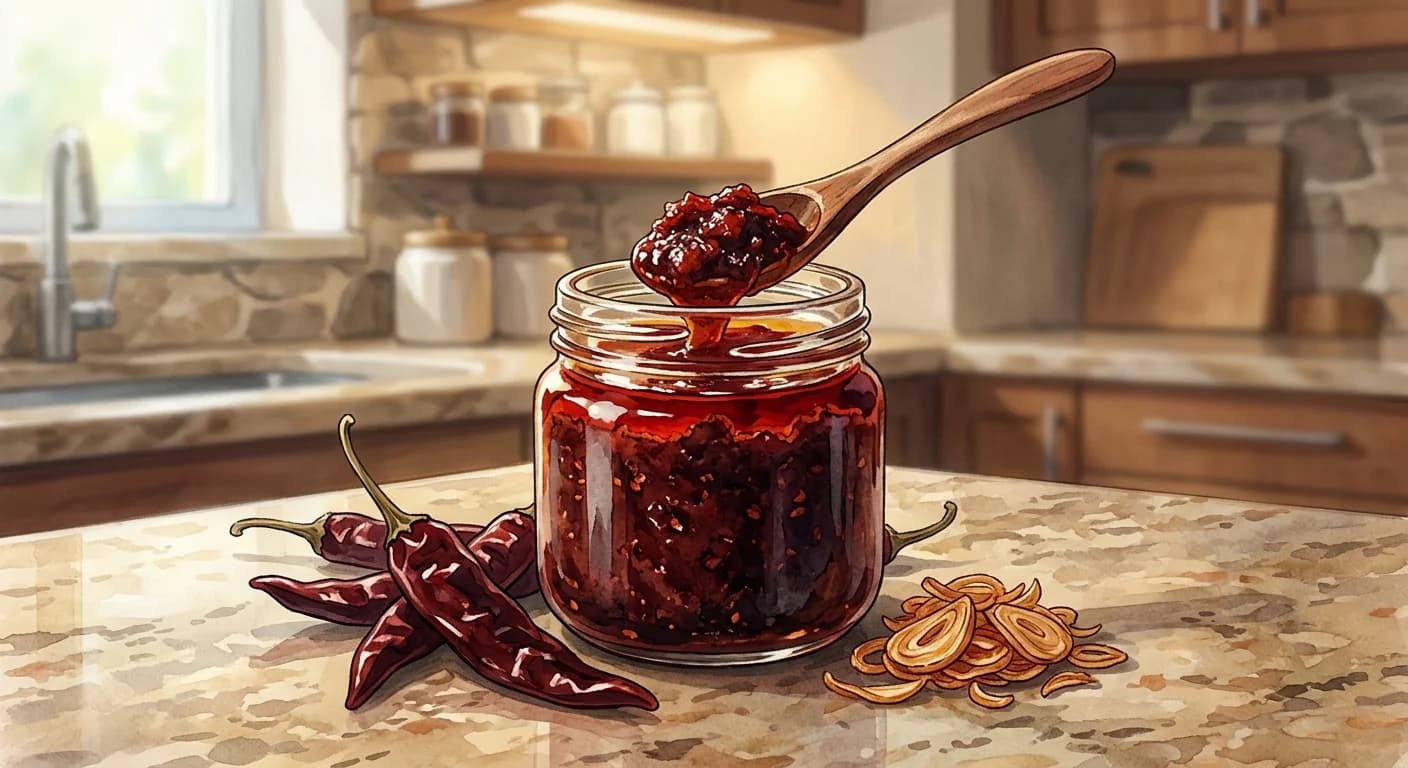
Open a jar of nam prik pao and the first thing you notice is the oil, a brick-red layer sitting on top of a paste so dark it's nearly black. Stir it and it smells of fried shallots, toasted chilies and the sea. Taste it and it is sweeter than you expect, then salty and sour, and the heat arrives last and stays mild.
It belongs to nam prik, the big Thai family of chili pastes and dips, but this one does two jobs. Spooned straight from the jar, it goes on rice, a fried egg or a slice of toast. Cooked into other dishes, it gives tom yum its orange color and sweet backbone, and it is the base of stir-fries sold all over Thailand as pad prik pao. In English it is often called chili jam, which describes the texture well.
Making it is mostly frying. The shallots, garlic, dried shrimp and chilies each go into the same pot of oil, one after another, because each one is done at a different moment. The shallots take about 10 minutes, the chilies take seconds, and a burnt batch of either makes the jam bitter. All of that flavor stays in the oil, and half of it goes back into the jam at the end.
The chilies here are large and mild, chosen for color and smoke more than fire. You control the heat with the seeds you save and grind back in.
Inspired by She Simmers and The Bittman Project.
At a Glance
Yield
About 1½ cups (twenty-four 1-tablespoon servings)
Prep
20 minutes
Cook
40 minutes
Total
1 hour
Difficulty
Medium
Ingredients
Fried Aromatics Ingredients
- 1½ ozlarge mild dried chilies (Thai long dried chilies, puya or guajillo), stemmed and seeded, seeds kept
- 3½ ozshallots, 3 to 4, peeled and thinly sliced
- 15 clovesgarlic, about 60 g, peeled and thinly sliced
- ¾ ozdried shrimp, about 1/4 cup
- 1 cupneutral oil, for frying; about half goes back into the jam
Jam Ingredients
- 1 tbspThai shrimp paste (kapi)
- ½ cuppalm sugar, chopped
- 3 tbspThai tamarind paste
- 3 tbspfish sauce, plus more to taste
- ½ cupwater
- —reserved chili seeds, to taste, for heat (optional)
Method
- 1
Prep the aromatics. Snip the chilies open with kitchen scissors, shake the seeds into a small bowl and keep them, then cut the chilies into 1-inch pieces. Slice the shallots and garlic as thin and even as you can, about 1/16 inch, and keep them in separate piles. Even slices brown at the same speed, which matters because a few scorched pieces make the whole jam bitter.
- 2
Set a fine-mesh strainer over a heatproof bowl and line a plate with paper towels. Heat the 1 cup of oil in a wok or medium saucepan over medium heat until a slice of shallot sizzles gently the moment it goes in, about 300°F (150°C). Fry the shallots, stirring often, for 8 to 12 minutes, until they are evenly golden brown and the bubbling slows down. Pour them into the strainer, then spread them on the paper towels. They darken a shade as they cool, so pull them a little early.
- 3
Return the oil to the pan and fry the garlic the same way, stirring, for 3 to 5 minutes, until light golden. Garlic goes from golden to bitter fast and keeps browning after it leaves the oil, so strain it as soon as it colors.
- 4
Return the oil to the pan again. Fry the dried shrimp for 1 to 2 minutes, until they smell toasty and turn crisp, and lift them out with a slotted spoon.
- 5
Add the chilies to the same oil and stir for 15 to 30 seconds, until they puff slightly and turn a deep brick red. Lift them out the moment they darken. Black chilies taste burnt, and there is no fixing that later. Turn off the heat and let the oil cool in the pan.
- 6
Put the chilies, shallots, garlic and shrimp in a food processor or a large mortar. Add chili seeds for heat: none for a mild jam, about a quarter of them for medium, more if you like it hot. Grind for 1 to 2 minutes, scraping down the sides, until you have a fine, slightly oily paste.
- 7
Measure 1/2 cup of the frying oil into a wide skillet or wok over medium heat. Keep the rest of the oil in a jar for stir-fries. Add the shrimp paste and mash it into the oil with a spatula for about 1 minute, until it smells strong and has broken up completely.
- 8
Add the palm sugar, tamarind paste, fish sauce and water and stir for about 2 minutes, until the sugar dissolves. Stir in the ground paste.
- 9
Cook at a lively simmer, stirring often and scraping the bottom of the pan, for 10 to 15 minutes. It is ready when the water has cooked off, the jam has turned a dark reddish brown, and oil pools around the edges. A spatula drawn through the middle should leave a path that holds for a few seconds. The jam sets up more as it cools, so stop when it is a little looser than you want.
- 10
Taste a little once it has cooled for a minute. It should taste sweet first, then salty, sour and slowly hot. If it tastes flat, add fish sauce 1 teaspoon at a time; if it tastes too sweet, add a little more tamarind. Let it cool completely, then spoon it into a clean jar with all its oil. You should have about 1 1/2 cups.
Key Ingredient Benefits
Dried chilies: Most of a chili's heat sits in the pale ribs that hold the seeds, and the seeds pick up plenty of it, so taking them out and adding some back gives you control. Chilies are studied mainly for capsaicin, the compound behind their burn. A 2022 review in Biomolecules found that diets rich in chili peppers are associated with a lower risk of dying from cardiovascular disease, but that dietary capsaicin has no clear effect on blood sugar or cholesterol. The authors suggest gut bacteria may explain the link, and that is still a hypothesis. The large mild chilies in this jam carry far less capsaicin than bird's eye chilies.
Tamarind: Its sourness comes mostly from tartaric acid, and it has a fruity, almost date-like flavor that lime juice doesn't have. In Thai cooking it is one of the main souring agents, used alongside lime.
Dried shrimp and shrimp paste: Drying and fermenting break down the shrimp's protein, which is where much of the jam's savory flavor comes from. Both are shellfish, so this jam is off limits for anyone with a shellfish allergy. The vegetarian version under Substitutions leaves them out.
Palm sugar: It tastes of caramel and is less sharply sweet than white sugar, but it is still sugar. A tablespoon of the jam has about 5 grams.
Sodium: Between the fish sauce, shrimp paste and dried shrimp, a tablespoon of the jam has roughly 270 mg of sodium. It is usually eaten a spoonful at a time, so it adds up slowly, but count it if you watch your salt.
Why This Works
Each aromatic browns at its own speed. Shallots hold a lot of water, so they need several minutes before they color. Sliced garlic has much less water, so it goes golden in a few minutes and bitter soon after. Dried chilies are already dry and scorch in under a minute. Frying them one at a time in the same oil lets you pull each one at its best, and the oil picks up flavor from all of them.
Chilies get their red color from carotenoids, and those dissolve in fat, not water. That is why the frying oil turns red, and why half a cup of it goes back into the jam. It carries color and flavor through the whole jar.
Shrimp paste smells harsh straight from the block. A minute in hot oil takes the edge off and turns that sharpness into savory depth before the sugar goes in.
Cooking until the oil separates drives off the water. That gives the jam its thick, spreadable texture and helps it keep. Once the water is gone, the palm sugar starts to caramelize a little, darkening the jam and adding a toasty bitterness against the sweetness.
Substitutions & Variations
Chilies: Puya and guajillo chilies, sold in Mexican groceries, are close to the large dried chilies used in Thailand: mild, deep red and slightly fruity. New Mexico chilies also work. For a hotter jam, fry 4 to 6 chiles de árbol along with the mild ones.
Vegetarian or vegan: Leave out the dried shrimp and the shrimp paste. In place of the fish sauce, use 3 tablespoons of light soy sauce, and stir 1 tablespoon of white miso into the oil where the shrimp paste would go. The jam comes out a little lighter in color and less funky, with soy's savoriness in place of the sea. Soy sauce adds soy and usually wheat, so use tamari if you need it gluten-free.
Tamarind: If you only have Indian tamarind concentrate, which is thicker and stronger, use 1 tablespoon. In a pinch, 2 tablespoons of lime juice stirred in after cooking gives the sourness but not the fruitiness.
Palm sugar: Light brown sugar works, measured the same. The jam will taste a little more like molasses.
Roasted instead of fried: This is the older method the name refers to. Char the unpeeled shallots and garlic and the chilies in a dry cast-iron pan or under the broiler until soft and blackened in spots (the chilies only need seconds), then peel and grind them with the shrimp. Cook the paste in 1/2 cup of fresh oil for 20 to 30 minutes, until thick. It comes out smokier and a little less sweet.
Serving Suggestions
The easiest way to eat it is on hot rice with a fried egg, the yolk still runny, and a few slices of cucumber on the side. It is also very good spread thin on buttered toast or crackers.
As an ingredient, it gives tom yum goong its color and sweetness; that recipe uses 1/4 cup. Stir a tablespoon into a stir-fry of chicken, shrimp or squid with Thai basil, or whisk a spoonful into a lime and fish sauce dressing for a seafood or glass noodle salad. The extra frying oil you kept tastes of shallot and chili and is great for frying eggs or rice.
Storage & Reheating
Fridge: Keep it in a clean, airtight jar for up to 1 month. Leave the layer of oil on top, since it protects the paste from air.
Freezer: It freezes for up to 6 months. Spoon it into an ice cube tray, freeze, then keep the cubes in a bag, so you can thaw one portion at a time.
Using cold jam: Straight from the fridge it is stiff. Stir it, or let a spoonful sit at room temperature for a few minutes. Always use a clean, dry spoon. Water and crumbs shorten its life.
Cultural Notes
Nam prik is a broad Thai term for chili pastes, relishes and dips, and nearly every region has its own. Northern Thailand has nam prik ong, a pork and tomato dip eaten with raw vegetables. Nam prik pao is the one you are most likely to find outside Thailand. According to Wikipedia, it contains chili peppers, shallots, garlic, fermented shrimp, tamarind, fish sauce and palm sugar.
Phao means to roast or burn in a fire, and it points to the older way of making the paste: charring the chilies, shallots and garlic over coals before pounding them. Most cooks now fry the ingredients instead, which is quicker and gives a sweeter, glossier jam. The roasted method is under Substitutions.
Nam prik pao is sold in jars all over Thailand and in Asian groceries abroad. Homemade tastes more of shallot and garlic and less of sugar.
Nutrition Facts
Calories: 84kcal (4%)|Total Carbohydrates: 7.4g (3%)|Protein: 1.2g (2%)|Total Fat: 5.8g (7%)|Saturated Fat: 0.4g (2%)|Cholesterol: 6mg (2%)|Sodium: 272mg (12%)|Dietary Fiber: 0.7g (3%)|Total Sugars: 5.2g
You Might Also Like
Ratings & Comments
Ratings & Comments
Ratings
Share your thoughts on this recipe.
Sign in to rate and comment