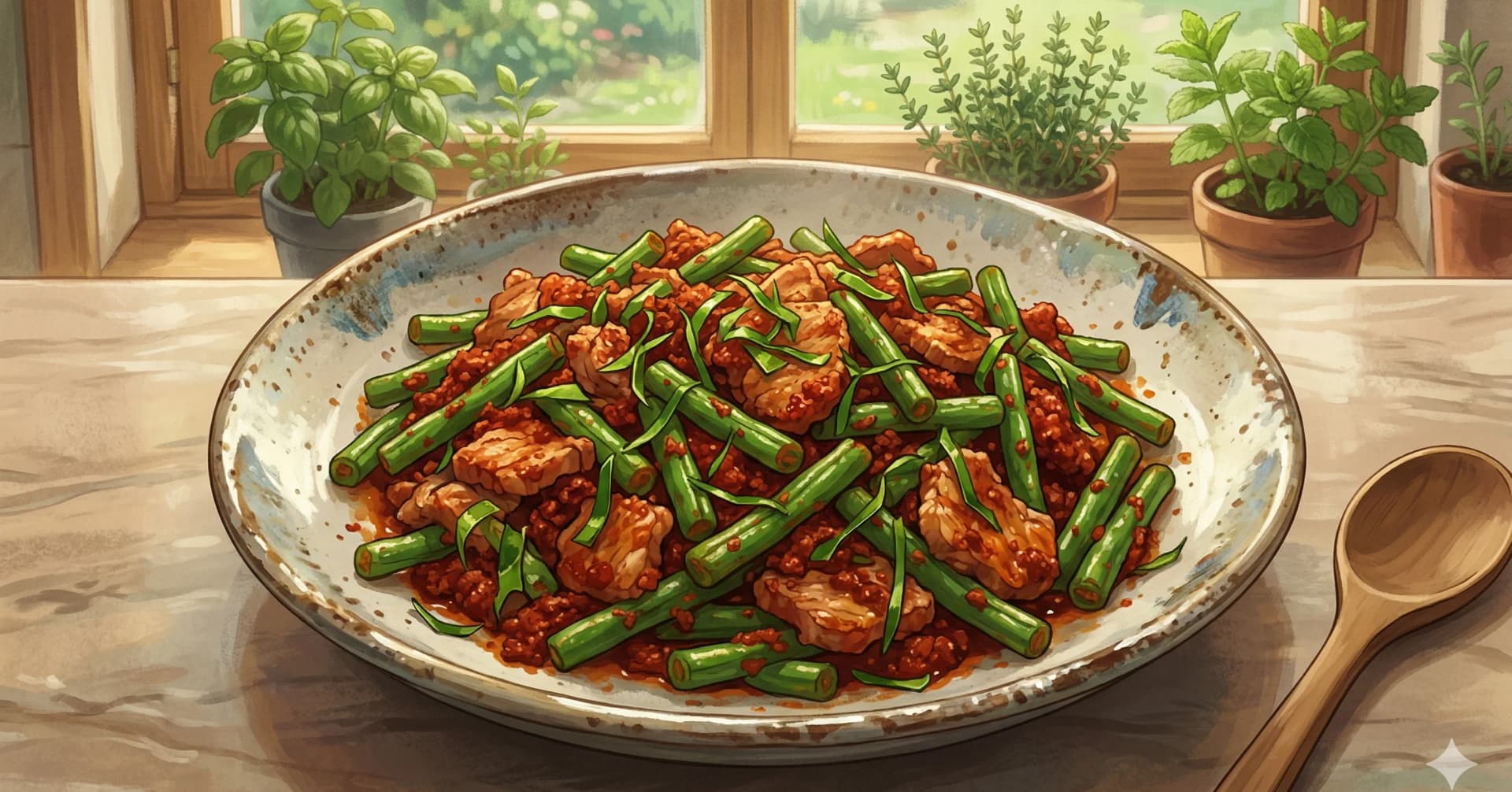
Thai Cuisine
Dry Red Curry Stir-Fry (Pad Prik King / ผัดพริกขิง)
Dry-fried green beans and protein in a fiery, fragrant red curry paste with makrut lime leaves
The moment the red curry paste hits the hot wok, the kitchen fills with an aroma so concentrated and complex that it stops you mid-breath. There is the citrus punch of galangal, the floral heat of dried chilies, the earthy warmth of coriander root, and beneath all of it, the faint brininess of shrimp paste binding everything together. Within seconds, the paste sizzles, darkens at the edges, and begins to release its oils. This is pad prik king at its most essential: a dry curry stir-fry built on the intensity of the paste itself, with no coconut milk to soften its edges and no broth to dilute its impact.
Pad prik king is one of Thailand's great weeknight dishes, fast enough for a busy evening but complex enough to satisfy anyone who knows Thai food well. The name translates roughly to "stir-fried with chili and ginger," referring to the prik king curry paste that forms its base. Unlike the wet curries (green, red, panang) that simmer in coconut milk, pad prik king is cooked dry. The paste clings directly to the ingredients, coating each green bean and slice of meat in a thick, glossy layer of concentrated flavor.
The dish delivers heat, sweetness, and savory depth in rapid succession, with the shredded makrut lime leaves providing a burst of citrus that cuts through the richness. Green beans are the traditional vegetable, chosen for their ability to stay crisp under high heat and absorb the paste without becoming soggy. The result is a dish with remarkable textural contrast: crunchy beans, tender meat, and the slightly grainy texture of the fried paste itself. Serve it over a mound of steaming jasmine rice and you have a meal that takes 25 minutes from start to plate.
At a Glance
Yield
2 servings
Prep
15 minutes
Cook
10 minutes
Total
25 minutes
Difficulty
Easy
Ingredients
- 7 ozpork loin or chicken thigh, thinly sliced against the grain
- 7 ozgreen beans (snake beans or French beans), trimmed and cut into 5 cm lengths
- 2 ozred curry paste (store-bought or homemade)
- 6makrut lime leaves, center rib removed, very finely shredded
- 1 tbspfish sauce
- 2⅓ tsppalm sugar or brown sugar
- 2 tbspneutral oil
- 1 tbspwater, if needed
- —Steamed jasmine rice
- —Extra makrut lime leaves, shredded, for garnish
Method
- 1
Prepare all ingredients before heating the wok. Slice the meat thin, cut the green beans, shred the lime leaves, and measure the curry paste, fish sauce, and sugar into small bowls. This dish moves fast once the wok is hot.
- 2
Heat a wok over high heat until a wisp of smoke appears. Add the oil and swirl to coat. When the oil shimmers, add the curry paste. Spread it across the wok surface and let it fry undisturbed for about 30 seconds. The paste will sizzle vigorously and darken slightly. Stir and fry for another 30 seconds until the oil begins to separate from the paste and the raw smell transforms into something deeply aromatic and toasty.
- 3
Add the sliced meat. Toss through the paste, coating every piece. Stir-fry for 2 minutes, spreading the meat against the wok surface to sear when possible. The meat should be nearly cooked through and evenly coated in the red paste.
- 4
Add the green beans. Toss to combine with the meat and paste. Stir-fry for 3 to 4 minutes, keeping the heat high. The beans should brighten in color and develop a few blistered spots but remain crisp and snappy when bitten. If the paste begins to stick and scorch, add a splash of water (no more than 15 ml) and scrape the wok.
- 5
Add the fish sauce and palm sugar. Toss for 30 seconds until the sugar dissolves and the seasoning is distributed. The fish sauce will sizzle on contact and intensify the savory depth.
- 6
Scatter the shredded makrut lime leaves over the stir-fry and toss twice to distribute them. The leaves should barely cook, releasing their citrus fragrance from residual heat alone.
- 7
Taste a bean. The flavor should be spicy and boldly savory, with a noticeable sweetness from the palm sugar and a bright, citrusy finish from the lime leaves. Adjust fish sauce for salt, sugar for sweetness, or add a teaspoon more curry paste for heat.
- 8
Transfer to a plate and serve immediately alongside steamed jasmine rice. Garnish with extra shredded lime leaves if desired. The rice is essential, as it tempers the heat and stretches the bold flavors of the paste across each bite.
Key Ingredient Benefits
Red curry paste (prik king): A concentrated blend of dried red chilies, garlic, shallots, lemongrass, galangal, coriander root, cumin, white pepper, and shrimp paste. The capsaicin in the chilies has been widely studied for metabolic and anti-inflammatory effects. Galangal contains galangin, a flavonoid researched for antioxidant properties. The paste delivers these compounds in concentrated form.
Makrut lime leaves: The leaves of Citrus hystrix, prized for their intense citrus fragrance. They contain citronellol, limonene, and citronellal, volatile compounds traditionally associated with calming and digestive properties in Thai herbal medicine. Shredding the leaves finely releases more of these aromatics than leaving them whole.
Green beans: A good source of fiber, vitamin C, vitamin K, and folate. Snake beans, the longer, darker variety traditional in Thai cooking, have a slightly higher protein content than standard green beans.
Why This Works
Frying the curry paste in oil before adding other ingredients is the foundation of the dish. The heat activates fat-soluble flavor compounds in the dried chilies, galangal, and lemongrass, extracting them into the oil where they become more volatile and aromatic. The brief period of undisturbed frying allows the sugars in the paste to caramelize slightly, adding depth that simply simmering the paste in liquid would not achieve.
The absence of coconut milk is deliberate. Without it, the curry paste has nowhere to hide. Its flavor is front and center, which means the quality of the paste matters enormously. A good red curry paste made with fresh galangal, lemongrass, and shrimp paste will produce a dramatically better dish than a paste made primarily from dried chili and salt.
Green beans hold up under high heat better than most vegetables, maintaining their crunch while absorbing enough paste to carry flavor. Snake beans (long beans), if available, are traditional and have a slightly chewier texture that works particularly well with the dry paste.
Substitutions & Variations
Protein: Chicken thigh, shrimp, firm tofu, or tempeh all work well. Shrimp cook faster, so add them after the green beans are nearly done. Tofu should be pressed and cubed, then pan-fried until golden before adding to the paste.
Vegetables: Substitute long beans, asparagus, or thinly sliced bell peppers. Crispy vegetables work best for this dry-fry technique.
Curry paste: If making from scratch is not feasible, Mae Ploy or Maesri red curry paste are widely available and produce good results. Add extra lime leaves and a pinch of ground coriander to boost the aromatic profile of store-bought paste.
Pad prik king with crispy pork belly: Slice cooked pork belly thin and add it to the paste instead of raw meat. The fat renders into the paste and creates a richer, more indulgent version.
Serving Suggestions
Pad prik king is most often part of a multi-dish Thai meal served family-style with rice. Pair it with a wet curry like green curry or panang curry for a contrast between dry and saucy preparations.
A bowl of tom kha gai alongside provides a creamy, coconut-based soup that cools the palate between bites of the fiery stir-fry. For a lighter counterpoint, som tam adds a raw, crunchy, sour element that complements the rich, cooked flavors of pad prik king.
For a quick weeknight dinner for two, pad prik king over rice with a fried egg on top and a squeeze of lime is all you need.
Storage & Reheating
Refrigerator: Store in a sealed container for up to 3 days. The green beans will soften slightly but the flavor remains excellent.
Reheating: Reheat in a hot wok or skillet over high heat for 2 minutes. Add a splash of water if the paste has dried out. The microwave works but softens the beans further.
Freezer: Not ideal, as the green beans lose their crunch. The cooked dish without the beans can be frozen for up to 1 month and served with freshly stir-fried beans.
Prep ahead: The curry paste, sliced meat, and cut beans can all be prepared up to a day ahead and refrigerated separately.
Cultural Notes
Pad prik king (ผัดพริกขิง, "stir-fried with prik king paste") is one of the drier Thai red curries, closer in style to a stir-fry than to a soupy curry. The name is slightly misleading: there is no ginger (khing in Thai) in the dish, despite "khing" sounding like "ginger" in English transliteration. The "king" in prik king refers to a specific style of red curry paste built without coconut milk, heavy on dried chilies, lemongrass, kaffir lime peel, galangal, and shrimp paste, pounded smooth and used as the base for the stir-fried preparation.
The cooking technique is closer to a wok stir-fry than to the slow-simmered curries of the gaeng phet family. The thick curry paste is fried hard in oil until aromatic and the spices darken, then the protein (most commonly pork, sometimes chicken, fish, or shrimp) is added and stir-fried briefly, followed by thua fak yao (Chinese long beans, also called yardlong beans) or thua khaek (snake beans) cut into 2-inch pieces. Kaffir lime leaves are torn and tossed in at the end for the dish's signature aromatic top note. Fish sauce and palm sugar adjust the seasoning. The finished dish is dry, intensely spiced, and clinging to the meat rather than swimming in sauce.
Pad prik king is most associated with central and southern Thai home cooking and is a standard dish on the khao rad gaeng one-plate-rice lunch counter. The dish takes well to longer simmering at lower heat (some versions hold the protein in the paste over a low flame for 10 to 15 minutes to develop deeper flavor), and the leftovers reheat better than many Thai stir-fries since the paste-coated meat does not dry out. Vegetarian preparations replace the meat with fried tofu cubes or with crispy pork rinds in non-Buddhist households.
Nutrition Facts
Calories: 327kcal (16%)|Total Carbohydrates: 15.5g (6%)|Protein: 24.8g (50%)|Total Fat: 18.7g (24%)|Saturated Fat: 4.1g (21%)|Cholesterol: 105mg (35%)|Sodium: 1280mg (56%)|Dietary Fiber: 4.4g (16%)|Total Sugars: 8g
You Might Also Like

Ratings & Comments
Ratings & Comments
Ratings
Share your thoughts on this recipe.
Sign in to rate and comment