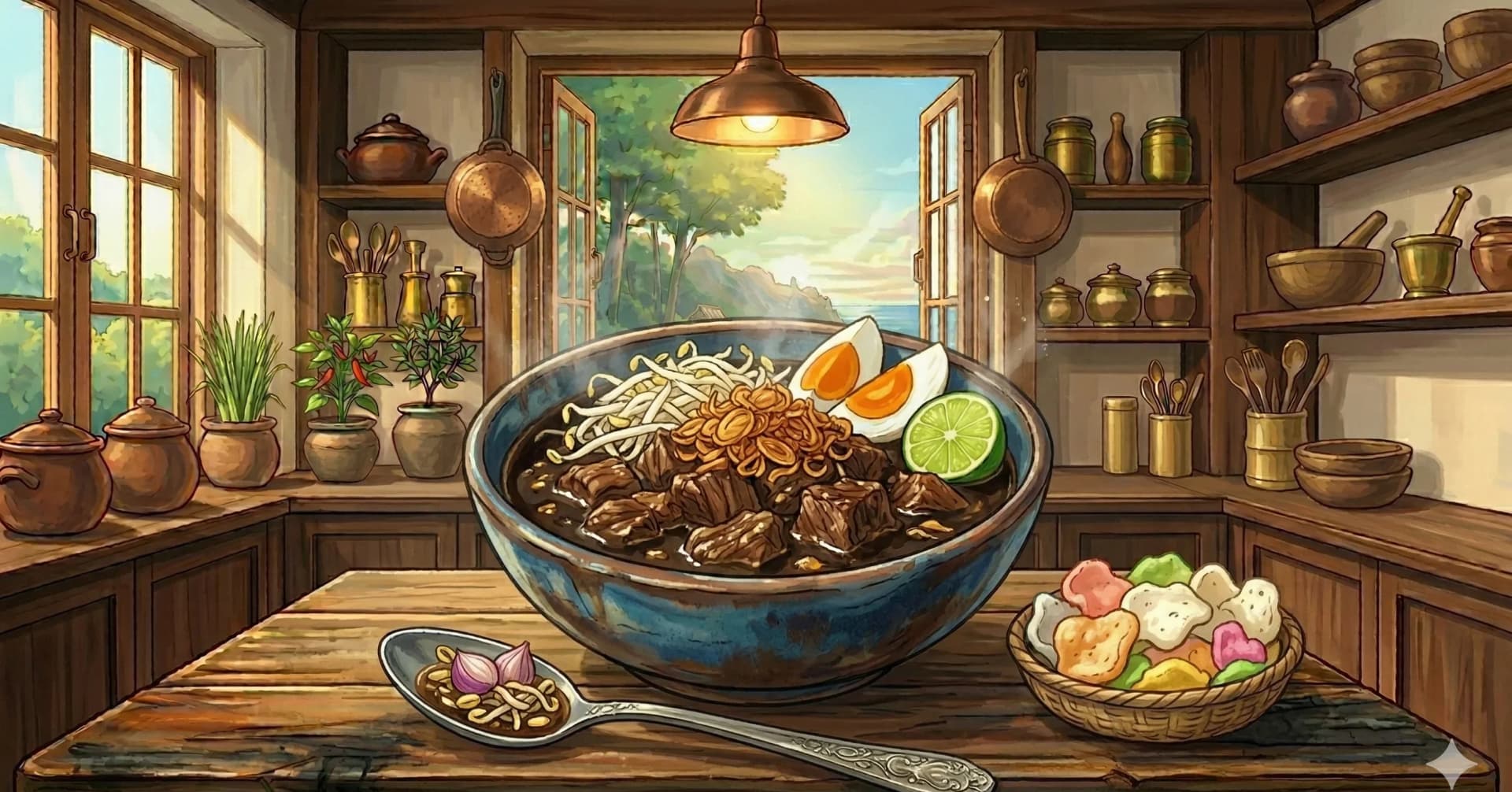
Indonesian Cuisine
Black Nut Beef Soup (Rawon)
East Javanese black beef soup with keluak, lemongrass, and galangal, served over rice with bean sprouts, salted egg, and fried shallots
Rawon is the signature dish of Surabaya and the broader East Java region. It is a beef soup of striking appearance, its broth an inky, near-black color that comes from keluak, the fermented seed of the Pangium edule tree. The first time you see rawon, you might hesitate. The color is unlike anything else in the Southeast Asian soup tradition. But the flavor is deeply savory, nutty, and complex, with none of the bitterness the dark broth might suggest. It is one of the great comfort foods of the Indonesian archipelago, eaten at home, in warung, and at celebrations.
The spice paste that forms the backbone of rawon is built from the same aromatics found across Javanese cooking: shallots, garlic, candlenuts, turmeric, galangal, and lemongrass. What sets rawon apart is the keluak. These seeds, once properly fermented and processed, contribute a dark, earthy richness that no other ingredient can replicate. The paste is fried until fragrant, then simmered with beef brisket or shank until the meat turns tender and the broth takes on its characteristic depth. Time is the only real technique here. The longer the soup simmers, the better it becomes.
Rawon belongs to the same family of slow-simmered, spice-paste-driven beef soups found across Southeast Asia. It shares kinship with Bo Kho, the Vietnamese beef stew fragrant with star anise and lemongrass, and with Pho Bo, where clarity of broth matters as much as depth of flavor. Among Indonesian soups, it sits alongside Soto Betawi, the creamy coconut beef soup of Jakarta, and Sup Kambing, the aromatic lamb broth. Pair it with a plate of Nasi Uduk for a meal that covers two corners of Java in a single sitting.
At a Glance
Yield
6 servings
Prep
30 minutes
Cook
2 hours 30 minutes
Total
3 hours
Difficulty
Medium
Ingredients
Spice Paste Ingredients
- 8shallots (about 120 g), peeled and roughly chopped
- 5 clovesgarlic, peeled and roughly chopped
- 3candlenuts (kemiri), roughly chopped (or substitute macadamia nuts)
- 3keluak seeds, flesh extracted (or 15 g ready-to-use keluak paste)
- 4 cmfresh turmeric, peeled and chopped (or 5 ml ground turmeric)
- 3 cmfresh ginger, peeled and chopped
- 2 cmlesser galangal (kencur), peeled and chopped
- 2¾ tspcoriander seeds (about 1 1/2 tsp)
- 1⅓ tspcumin seeds
- ¼ ozshrimp paste (terasi), about 1/2 tsp
- ½ tsptamarind paste (about 1/2 tsp)
Broth Ingredients
- 1¾ lbbeef brisket or beef shank, cut into 3 cm chunks
- 2 qtwater
- 2 tbspneutral oil (such as vegetable or peanut oil)
- 4 cmgalangal, peeled and bruised with the flat of a knife
- 2 stalkslemongrass, bruised and tied into knots
- 4kaffir lime leaves, central vein removed, leaves torn
- 2Indonesian bay leaves (daun salam), or substitute regular bay leaves
- ⅞ tspwhite pepper powder (about 1/2 tsp)
- —Fine salt to taste (start with about 10 g, or 2 tsp)
- 1¼ tsppalm sugar or brown sugar, optional
To Serve
- 7 ozfresh bean sprouts, tails trimmed
- 3salted duck eggs, boiled and quartered
- 2 ozfried shallots (bawang goreng)
- 2limes, cut into wedges
- —Steamed white rice
- —Sambal terasi or sambal oelek
- —Kerupuk (shrimp crackers, optional)
- —Fresh Chinese celery leaves (daun seledri), chopped
Method
- 1
Prepare the keluak. If using whole keluak seeds, crack each one open along the seam using a heavy knife or nutcracker. Scoop out the dark, soft flesh inside. It should be black or very dark brown and have a slightly fermented, nutty smell. If the flesh is hard and dry, soak it in warm water for 30 minutes until it softens to a paste-like consistency. If using packaged ready-to-use keluak paste, measure it out and set aside.
- 2
Toast the coriander and cumin seeds in a dry skillet over medium heat, shaking the pan frequently, until they become fragrant and darken slightly, about 2 minutes. You will smell the coriander first, warm and citrusy, followed by the earthier cumin. Transfer to a plate and let cool.
- 3
Combine all spice paste ingredients in a blender or food processor: the shallots, garlic, candlenuts, keluak flesh, turmeric, ginger, lesser galangal, toasted coriander and cumin, shrimp paste, and tamarind. Add 30 to 45 ml of water to help the blades catch. Blend to a smooth paste, scraping down the sides as needed. The paste will be very dark, almost black, from the keluak.
- 4
Place the beef chunks in a large heavy-bottomed pot or Dutch oven and add the 2 litres of water. Bring to a boil over high heat. As the water heats, grey foam will rise to the surface. Skim this away with a ladle or fine mesh strainer until the broth runs mostly clear. This takes about 5 minutes of patient skimming. Reduce the heat to a gentle simmer.
- 5
While the beef simmers, heat the oil in a skillet over medium heat. Add the blended spice paste and fry, stirring constantly to prevent sticking, until the paste darkens further, the raw smell fades, and the oil begins to separate from the solids. This takes 5 to 7 minutes. The paste will go from smelling sharp and pungent to deeply aromatic, with a roasted, nutty quality from the keluak.
- 6
Scrape the fried spice paste into the pot with the beef and broth. Stir to combine. Add the bruised galangal, lemongrass knots, torn kaffir lime leaves, bay leaves, and white pepper. Stir once more.
- 7
Bring the soup back to a gentle simmer. Cover the pot with the lid slightly ajar and cook over low heat for 2 hours. Check occasionally, skimming any oil or foam from the surface if you prefer a cleaner broth. The beef is done when it yields easily to a fork but still holds its shape. The broth should be dark, rich, and deeply fragrant.
- 8
Taste the broth and season with salt, adding it gradually. The keluak provides a natural savory depth, so you may need less salt than you expect. Add palm sugar if the broth tastes slightly bitter or needs rounding out. Remove and discard the lemongrass, galangal, and bay leaves.
- 9
Prepare the garnishes. Blanch the bean sprouts in boiling water for 30 seconds, then drain and rinse briefly under cold water. They should be barely wilted, still crunchy at the core.
- 10
Serve the rawon in deep bowls. Place a mound of steamed rice to one side of each bowl, or serve the rice separately. Ladle the dark broth over the rice or alongside it, making sure each bowl gets several chunks of beef. Top with a handful of blanched bean sprouts, a quarter of salted duck egg, a generous pinch of fried shallots, and a scattering of Chinese celery leaves. Set lime wedges, sambal, and kerupuk on the table for each person to add as they like.
Key Ingredient Benefits
Keluak (Pangium edule): The defining ingredient of rawon. These large seeds come from the kepayang tree native to Southeast Asia. Raw keluak contains hydrogen cyanide and must be fermented (typically buried in ash and earth for weeks) before it is safe to eat. All commercially available keluak has been properly processed. The flesh is dark brown to black, with a texture somewhere between soft cheese and chocolate truffle. It has a deep, earthy, slightly smoky flavor unlike anything else in the spice pantry. Keluak is also used in Peranakan cooking, most famously in ayam buah keluak. It can be found in Southeast Asian grocery stores, sometimes labeled as "kluwek" or "keluwak," either as whole seeds or as ready-to-use paste.
Lesser galangal (kencur): Not the same as regular galangal (laos). Kencur is smaller, paler, and has a distinctive camphor-like aroma with peppery warmth. It is used throughout Javanese cooking and is sometimes sold as "aromatic ginger" or "sand ginger." If unavailable, substitute with an equal amount of fresh ginger, though the flavor will be different. Kencur has been used in Javanese traditional medicine (jamu) as a digestive tonic.
Candlenuts (kemiri): Waxy, cream-colored nuts used as a thickener and to add body to spice pastes throughout Indonesian and Malaysian cooking. They are mildly toxic when raw and should always be cooked. Macadamia nuts or raw cashews work as substitutes, providing similar fat content and texture without the slightly bitter edge of candlenuts.
Shrimp paste (terasi): Fermented shrimp paste that adds umami depth to the spice base. A small amount goes a long way. The smell is intense when raw but mellows considerably when fried. Terasi is denser and more pungent than Thai shrimp paste (kapi), though the two can be used interchangeably in a pinch.
Tamarind: Adds a gentle sourness that balances the richness of the keluak and beef. The amount is subtle here, just enough to brighten the broth without making it taste sour. Use tamarind concentrate or pulp dissolved in a little warm water.
Why This Works
The dark color and deep flavor of rawon come from the Maillard reaction and oxidation compounds in fermented keluak seeds. During the weeks-long fermentation process, the seeds develop melanoidins and other complex flavor compounds similar to those found in fermented black garlic or soy sauce. These molecules are heat-stable, so they survive the long simmer and infuse the broth with a savory, nutty quality that no combination of other spices can replicate.
Frying the spice paste before adding it to the broth is a standard technique across Indonesian cooking, and it matters here. Raw spice pastes taste sharp and one-dimensional. Frying drives off moisture, concentrates flavors, and triggers browning reactions in the shallots, garlic, and candlenuts. The oil also acts as a solvent for fat-soluble flavor compounds in the turmeric, ginger, and galangal, carrying them more efficiently into the broth.
The combination of galangal in the paste and galangal as a whole bruised piece in the broth creates two layers of the same flavor at different intensities. The blended galangal dissolves into the base, providing a persistent background warmth. The bruised piece releases its oils more slowly over the long simmer, adding a brighter, more resinous top note that keeps the soup from tasting flat.
Skimming the broth in the early stages removes proteins and impurities that would otherwise cloud the soup and contribute off-flavors. While rawon is not a clear broth in the way that Pho Bo demands transparency, a well-skimmed rawon has a cleaner, more focused flavor.
Substitutions & Variations
Keluak: There is no true substitute for keluak, as its flavor and color are unique. If completely unavailable, some cooks use a combination of 15 ml dark soy sauce and 10 g black sesame paste to approximate the color, though the flavor will be noticeably different. The soup will still be good, but it will not be rawon in the traditional sense.
Beef cut: Brisket is traditional because it becomes tender while retaining structure over a long simmer. Beef shank, chuck, or short ribs all work well. Shank adds gelatin to the broth, giving it a richer body. Oxtail makes a luxurious variation but requires closer to 3 hours of simmering.
Lesser galangal (kencur): Substitute with an equal amount of fresh ginger or 3 g (1/2 tsp) of kencur powder if fresh is unavailable.
Candlenuts: Replace with an equal number of raw macadamia nuts or raw cashews.
Pressure cooker method: After frying the spice paste and combining everything in the pressure cooker, cook on high pressure for 45 minutes with natural release. The beef will be tender and the broth deeply flavored.
Slow cooker method: Brown the beef and fry the spice paste on the stove, then transfer everything to a slow cooker with the remaining ingredients. Cook on low for 6 to 8 hours or on high for 3 to 4 hours.
Richer broth: Some East Javanese cooks add 2 to 3 tablespoons of coconut cream in the last 10 minutes of cooking for a slightly richer, more rounded broth. This is not traditional in all versions but is a common regional variation.
Vegetarian version: Replace the beef with firm tofu and tempeh chunks, use mushroom stock in place of water, and omit the shrimp paste. The keluak still provides remarkable depth even without meat.
Serving Suggestions
Rawon is always served with steamed white rice. The dark broth spooned over plain rice is one of the great pleasures of Indonesian cooking, the rice absorbing the rich, nutty liquid like a sponge. Bean sprouts are not optional; their fresh crunch and mild sweetness provide essential contrast to the deep, heavy broth. Salted duck egg adds a creamy, briny richness that pairs naturally with the earthy keluak. Fried shallots bring sweetness and crunch. A squeeze of lime at the table brightens everything.
Beyond the traditional garnishes, rawon pairs well with the same accompaniments you would find at a Surabaya warung: sambal terasi for heat, kerupuk for crunch, and sliced fresh chilies for those who want more fire. Nasi Uduk makes a fine substitute for plain rice, its coconut fragrance complementing the earthy broth. For a larger spread, serve rawon alongside Sayur Asem, the sour tamarind vegetable soup, for a contrast of light and dark. It belongs on the same table as Bak Kut Teh, the peppery pork rib broth from the Hokkien tradition, both being deeply spiced, slow-simmered meat soups that reward patience and time.
Storage & Reheating
Broth and beef: Store in an airtight container in the refrigerator for up to 4 days. Rawon improves significantly after a night in the refrigerator as the flavors continue to meld and deepen. Reheat gently on the stove over medium-low heat until the broth simmers and the beef is warmed through. Avoid boiling vigorously, which can break down the beef further than intended.
Freezing: The soup (broth and beef together) freezes well for up to 3 months. Cool completely before transferring to freezer-safe containers, leaving 2 cm of headspace for expansion. Thaw overnight in the refrigerator and reheat on the stove.
Garnishes: Prepare bean sprouts, salted eggs, and fried shallots fresh each time you serve. Blanched bean sprouts turn limp within hours. Fried shallots can be stored in an airtight container at room temperature for up to 3 days but will lose crispness; a brief toss in a dry pan restores some crunch.
Rice: Store and reheat rice separately. Leftover rice keeps in the refrigerator for up to 2 days. Sprinkle with a little water, cover, and microwave in 30-second intervals, or steam for 5 minutes.
Batch cooking: Rawon is an ideal make-ahead dish. Double the recipe and freeze half. The flavor only improves with time.
Cultural Notes
Rawon is the signature soup of East Java and of Surabaya in particular. The dish's striking visual identity, a soup so dark it appears nearly black, comes entirely from keluak (also spelled keluwak or kluwek), the fermented seed of the kepayang tree (Pangium edule). Raw keluak seeds contain hydrogen cyanide and are toxic, but a traditional fermentation process (soaking, burying in ash for 40 days, then thoroughly drying) neutralizes the cyanide and develops the seed's distinctive earthy, slightly truffle-like, nutty flavor. The process of preparing keluak is treated as one of the most technically demanding processes in Indonesian traditional cooking.
The origins are debated among Indonesian food historians, but most place the dish in 13th-century East Java, possibly originating in the kitchens of the Majapahit Empire that ruled much of what is now Indonesia from its capital near present-day Surabaya. The dish appears in old Javanese manuscripts and was likely a court dish before becoming a popular everyday food. Today, Surabaya is its undisputed cultural capital, and Rawon Surabaya is a protected geographical-indication brand within Indonesia.
The traditional Surabaya serving format is rawon setan ("devil rawon"), served late into the night at street stalls and warung that cater to night-shift workers, post-drinking customers, and insomniacs. The most famous late-night Surabaya rawon stalls have run continuously for over 50 years and develop deeply loyal customer bases. The dish is typically served with steamed rice, raw bean sprouts, salted egg (telur asin), fried shallots, krupuk crackers, and a small dish of sambal terasi (shrimp paste sambal). The contrast between the dark, deeply savory broth and the bright fresh accompaniments is part of the dish's sensory signature.
Nutrition Facts
Calories: 373kcal (19%)|Total Carbohydrates: 3g (1%)|Protein: 22g (44%)|Total Fat: 27g (35%)|Saturated Fat: 10g (50%)|Cholesterol: 90mg (30%)|Sodium: 780mg (34%)|Dietary Fiber: 1g (4%)|Total Sugars: 1g
You Might Also Like
 Easy
EasyIndonesian Cuisine
Bubur Ayam (Indonesian Chicken Rice Porridge)
1 hour 10 minutes
 Medium
Indonesian Cuisine
Ayam Goreng Lengkuas (Galangal Fried Chicken)
1 hour 45 minutes
 Medium
Vietnamese Cuisine
Spicy Beef Noodle Soup (Bún Bò Huế)
3 hours 45 minutes
 Easy
EasyVietnamese Cuisine
Cháo Gà (Vietnamese Chicken Rice Porridge)
1 hour 30 minutes
Ratings & Comments
Ratings & Comments
Ratings
Share your thoughts on this recipe.
Sign in to rate and comment