Chinese Cuisine
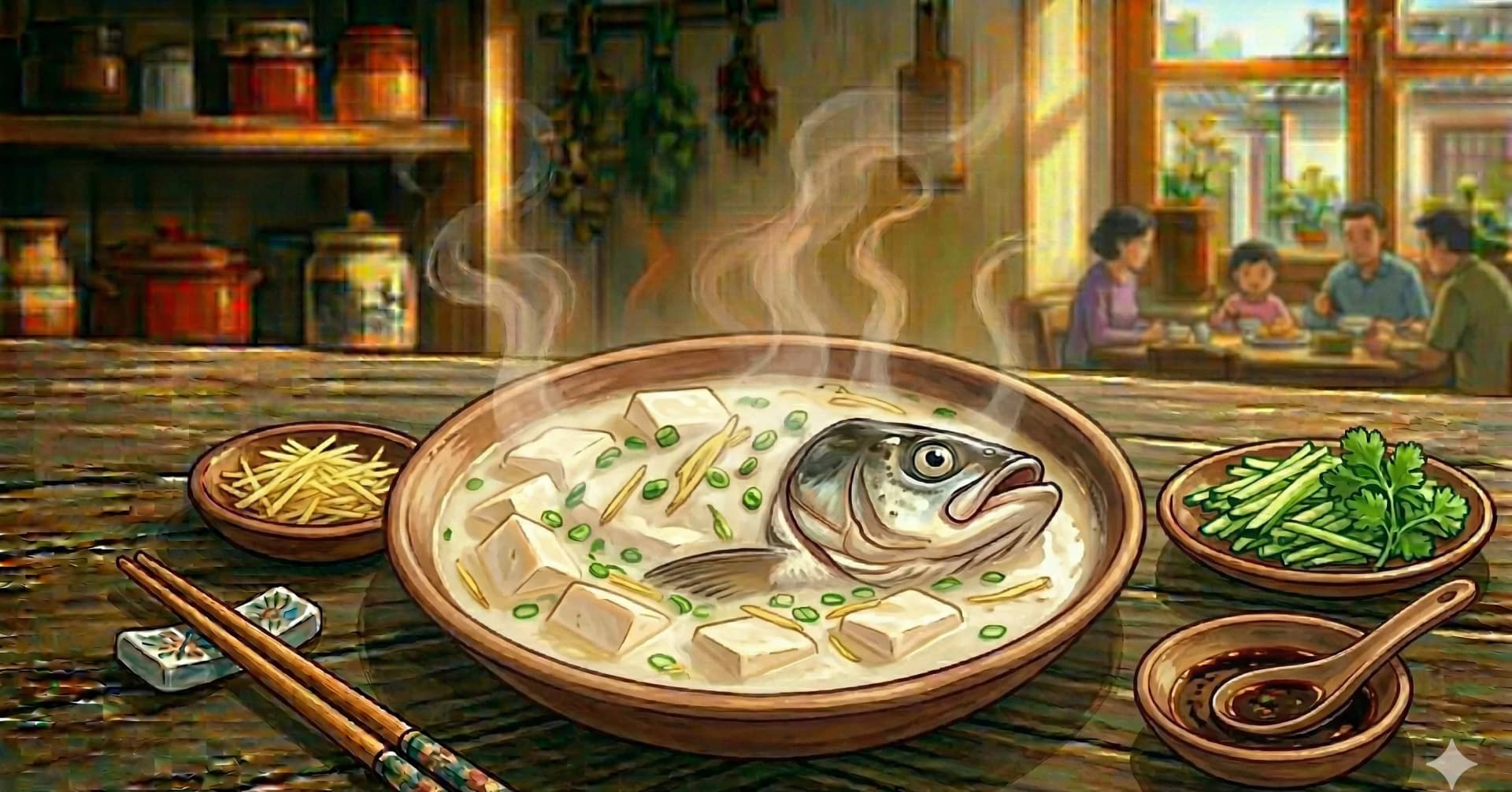
Yu Tou Dou Fu Tang (Fish Head Tofu Soup)
A milky-white, collagen-rich broth where a seared fish head and silken tofu produce one of Chinese cooking's greatest soups
The first time you make this soup and watch the broth turn from clear to opaque, milky white in the space of twenty minutes, it feels like a small miracle. You have not added cream, milk, or any thickener. The whiteness comes entirely from the fish: its fat and collagen, extracted by high heat and vigorous boiling, emulsify into the water and create something that looks and feels like it should not be possible from so few ingredients.
Yu tou dou fu tang is one of those recipes that reveals how much flavor Chinese cooks can pull from parts that Western kitchens often discard. A fish head is full of collagen, fat, and gelatinous connective tissue, all the things that make a broth feel rich and satisfying on the lips. The technique has two critical steps. First, the fish head must be seared in hot oil until golden and crisp on both sides. This builds a Maillard crust that adds depth and flavor. Second, the broth must boil hard, not simmer gently. The vigorous agitation is what emulsifies the fat into the water and produces that signature milky appearance.
The tofu is the quiet partner in this dish. Cubes of soft or medium-firm tofu absorb the fish broth as they cook, becoming tender pillows of concentrated flavor. Between the richness of the broth, the custard-like tofu, and the delicate fish flesh clinging to the head, this is a soup of textures and subtlety. White pepper and a scattering of scallion greens are all it needs at the end.
At a Glance
Yield
4 servings
Prep
15 minutes
Cook
40 minutes
Total
55 minutes
Difficulty
Medium
Ingredients
- 1large fish head, bighead carp, grass carp, or salmon head (about 680 g), split in half and cleaned
- 1 tspsalt for rubbing the fish head
- 1block soft or medium-firm tofu (about 400 g), cut into 1-inch cubes
- 1thumb-sized piece fresh ginger, sliced into 6 to 8 coins
- 4scallions, white and green parts separated, cut into 2-inch lengths
- 3 clovesgarlic, lightly smashed
- ¼ ozdried shrimp, rinsed and soaked for 15 minutes (optional)
- 2 tbspvegetable or peanut oil
- 2 tbspShaoxing wine
- 1½ qtboiling water
- 1 tspsalt, plus more to taste
- —White pepper to taste
- —Scallion greens, thinly sliced
- —A few drops of sesame oil (optional)
Method
- 1
Prepare the fish head. Rinse the fish head halves thoroughly under cold running water. Remove any remaining scales, gills, or blood clots. Pat completely dry with paper towels. This step is essential. Moisture on the fish will cause the oil to splatter violently when you sear it. Rub the fish head pieces with 1 tsp salt and let them sit for 5 minutes, then pat dry again.
- 2
Sear the fish head. Heat 2 tbsp oil in a wok or large skillet over high heat until the oil begins to shimmer. Carefully lay the fish head pieces in the wok, cut side down. Sear without moving for 3 to 4 minutes until a deep golden crust forms. Flip and sear the other side for another 3 minutes. The fish should be well browned on both sides. This crust is what gives the broth its depth of flavor.
- 3
Deglaze and add aromatics. Push the fish head to one side and add the ginger coins, scallion whites, garlic, and dried shrimp to the wok. Stir-fry the aromatics for 30 seconds until fragrant. Splash in the Shaoxing wine and let it sizzle and reduce for a few seconds. The alcohol will flash off and leave behind a warm, fermented sweetness.
- 4
Build the milky broth. Pour in 6 cups of boiling water. This is critical: the water must be boiling, not cold or warm. Adding boiling water to the hot, seared fish is what shocks the collagen and fat into emulsifying, producing the milky-white broth. Bring to a hard boil over high heat and keep it there. Do not reduce to a simmer. Let the soup boil vigorously for 15 minutes. You will see the broth transform from clear to translucent to fully opaque white within the first 10 minutes.
- 5
Add the tofu. Gently slide the tofu cubes into the boiling broth. Reduce the heat to medium so the broth continues to bubble but not so violently that it breaks the tofu apart. Cook for another 10 minutes. The tofu will absorb the fish broth and become silky and flavorful.
- 6
Season and serve. Season with salt and a generous amount of white pepper. Taste and adjust. The soup should be clean, rich, and faintly sweet from the fish. Ladle into bowls, making sure each serving gets a portion of tofu and some of the fish head. Scatter with sliced scallion greens and add a few drops of sesame oil if you like.
Key Ingredient Benefits
Fish Head. The most collagen-rich part of the fish, containing significant amounts of omega-3 fatty acids, particularly in oily species like salmon and carp. The cheek meat is considered the most prized part, with a texture often compared to crab or lobster. Fish heads are also a source of calcium (from the bones) and phosphorus. In TCM, fish head soup is traditionally associated with nourishing the brain and supporting cognitive function.
Soft Tofu. Made from soybeans, tofu is a complete plant protein containing all essential amino acids. It is a source of calcium (especially if made with calcium sulfate as a coagulant), iron, and isoflavones. Research suggests regular soy consumption may support cardiovascular health, though individual responses vary.
Shaoxing Wine. A fermented rice wine essential to Chinese cooking. It adds a warm, slightly sweet depth to broths and sauces. In this recipe, it also helps neutralize any fishy odor from the head. If unavailable, dry sherry is the closest substitute.
Ginger. Essential in Chinese fish cookery for neutralizing fishy aromas. The volatile compounds in ginger react with trimethylamine (the compound responsible for "fishy" smell) and reduce its perception.
Why This Works
The milky-white broth is not a mystery once you understand the science. Fish heads are loaded with collagen, gelatin, and fat. When you sear the head first in hot oil, you build a flavorful crust through the Maillard reaction and begin to render some of the fat. When boiling water hits this hot, oil-coated surface, the fats and collagen are violently agitated and forced into a stable emulsion with the water. This is the same process that makes a French beurre blanc or a properly emulsified pan sauce. The key is high heat and vigorous boiling. A gentle simmer will not achieve the same result, and you will end up with a clear broth and pools of separated fat instead.
Starting with boiling water rather than cold is the single most important technique in this recipe. Cold water extracts collagen and fat slowly, but it does not emulsify them. The thermal shock of boiling water against the seared fish is what forces the emulsion to form. This same approach appears in many Jiangsu and Cantonese fish soup traditions.
The tofu plays a structural and textural role. Its porous surface absorbs the rich broth, turning each cube into a concentrated delivery system for the fish flavor. Soft or medium-firm tofu works best because it has enough structure to hold together during cooking but is tender enough to feel custard-like in the mouth. Firm tofu works but will not absorb as much broth.
White pepper, as in Dong Gua Tang, is the traditional finishing spice. Its aromatic, slightly floral heat complements fish far better than black pepper does, and it does not leave visible dark specks in the white broth.
Substitutions & Variations
No fish head? Use a whole small fish (tilapia, sea bass, or snapper), scored on both sides, and follow the same searing method. The broth will be slightly less rich but still milky. Fish fillets will not produce the milky effect because they lack the collagen and fat of the head and bones.
Salmon head. Produces an exceptionally rich, fatty broth with a deeper flavor. Salmon heads are often available inexpensively at fish markets and Asian grocery stores. The broth will have a slight orange tint.
Napa cabbage or mushrooms. Sliced napa cabbage or fresh enoki mushrooms can be added alongside the tofu for variety. Add them in the last 5 minutes so they stay tender without overcooking.
Vermicelli. A handful of rice vermicelli or glass noodles added in the last 3 minutes turns this into a more substantial one-bowl meal.
Spicy version. Add 1 tbsp doubanjiang (fermented chili bean paste) when frying the aromatics for a spicier, reddish-tinged variation.
Serving Suggestions
This soup is best served immediately, while the broth is at its most opaque and emulsified. It makes a satisfying light meal on its own with steamed rice on the side.
For a multi-dish dinner, pair it with something bold and savory like Gong Bao Ji Ding or Mapo Tofu. The richness of the fish broth plays well against the heat and intensity of Sichuan dishes.
A simple dipping sauce of soy sauce, finely minced ginger, and a splash of Chinkiang vinegar served alongside is traditional for the fish head pieces. The tender cheek meat, picked out with chopsticks, is considered the best part.
The soup also pairs beautifully with Congee for a comforting, all-broth-and-starch kind of meal.
Storage & Reheating
The soup is best eaten fresh. The milky emulsion will partially separate upon cooling and reheating, and while the flavor remains excellent, the broth will not look as pristinely white the second time around.
If you must store it, refrigerate for up to 2 days. Reheat gently on the stovetop over medium heat, whisking occasionally to re-emulsify the broth as much as possible.
The tofu will become slightly more porous and spongy after refrigeration, which is not necessarily a bad thing. It will absorb even more broth. The fish head meat is best eaten the day it is made.
This soup does not freeze well due to the emulsion breaking down and the tofu changing texture.
Cultural Notes
Yu tou dou fu tang (魚頭豆腐湯, "fish head and tofu soup") is the Shanghainese and broader Jiangnan soup of pan-seared fish head simmered with soft tofu cubes, ginger, scallion, and a small amount of Shaoxing wine until the broth becomes milky-white from the emulsified fish fat and the tofu absorbs the rich flavor. The dish takes advantage of the cut of fish that Western kitchens typically discard: the head of a large freshwater carp or sea fish contains substantial collagen, gelatinous tissue, and meat in the cheeks and around the eyes that release into the broth during the simmer and give the soup its signature creamy white color and rich body.
The technique relies on a specific browning step. The fish head (split lengthwise so the cooking liquid can reach every interior surface) is dried thoroughly with paper towels and pan-fried in hot oil with sliced ginger until both cut sides develop a golden-brown crust. The browning is critical: it both develops Maillard flavor compounds that enrich the broth and emulsifies the fish fat into the liquid during the subsequent simmer, producing the milky-white color that defines the dish. After browning, hot water and a small amount of Shaoxing wine are added directly to the pan and brought to a vigorous boil for fifteen to twenty minutes, during which the fat emulsifies and the broth turns opaque white. Cubes of soft tofu go in for the final ten minutes, and the soup is finished with chopped scallion and a small amount of salt.
The dish illustrates a defining principle of Jiangnan cooking: the celebration of ingredients that other cuisines might overlook. Fish heads, fish tails, pork trotters, chicken feet, and other low-status cuts are treated in Shanghai and the broader Jiangnan region as opportunities for specific techniques that extract maximum flavor and texture from materials that would otherwise be discarded. The soup appears at home dinners, at small neighborhood restaurants, and at upscale Jiangnan banquets in slightly elevated form. Fuchsia Dunlop's Land of Fish and Rice documents the technique in detail and notes the dish's particular cultural standing in the region.
Nutrition Facts
Calories: 321kcal (16%)|Total Carbohydrates: 5g (2%)|Protein: 38g (76%)|Total Fat: 16g (21%)|Saturated Fat: 2.8g (14%)|Cholesterol: 78mg (26%)|Sodium: 1314mg (57%)|Dietary Fiber: 0.8g (3%)|Total Sugars: 1g
You Might Also Like

Ratings & Comments
Ratings & Comments
Ratings
Share your thoughts on this recipe.
Sign in to rate and comment