Chinese Cuisine
Gui Hua Gou Qi Tang (Osmanthus Sweet Soup)
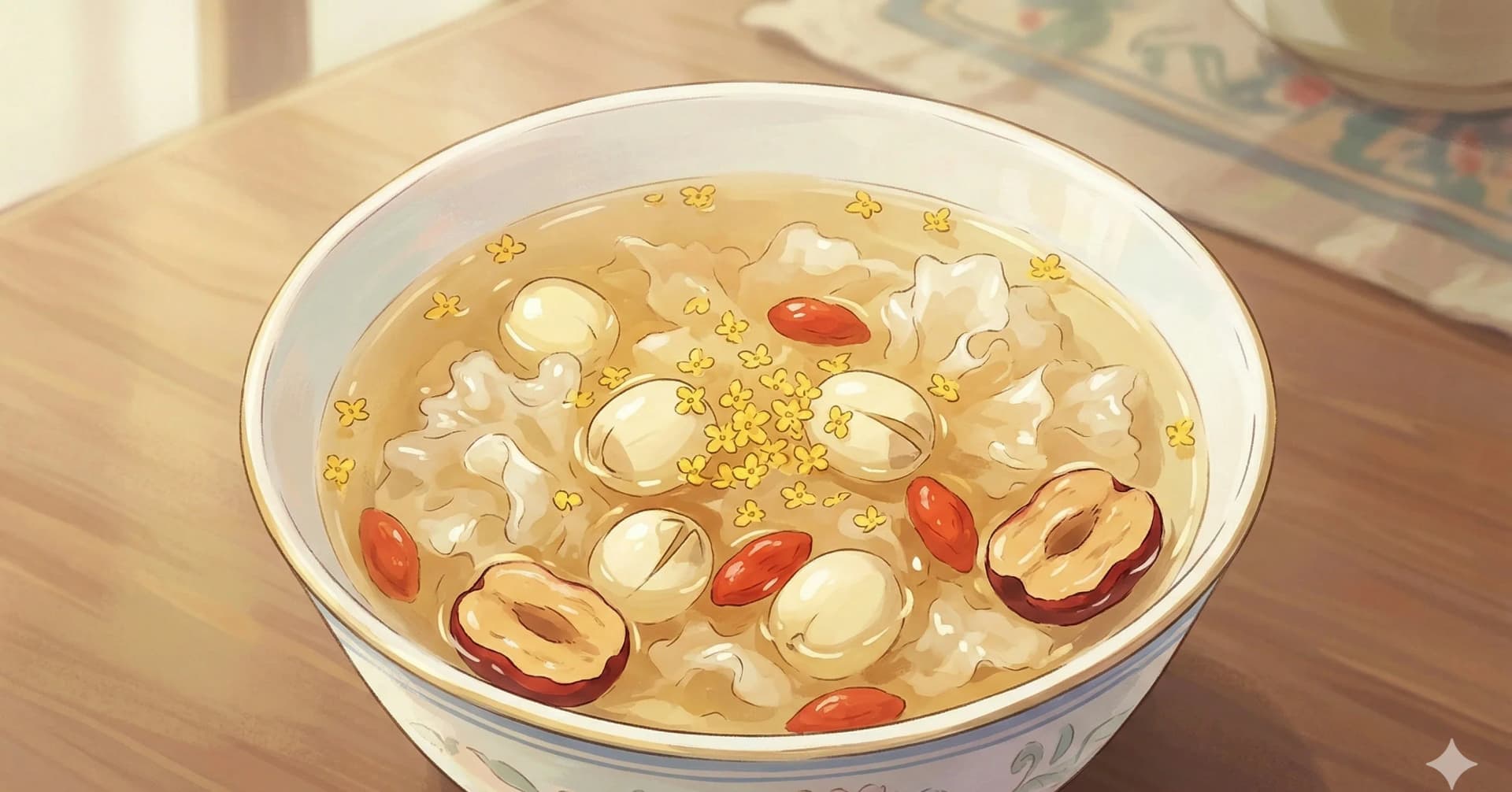
A light, fragrant dessert soup of osmanthus flowers, goji berries, and lotus seeds
Chinese sweet soups, collectively called tang shui, occupy a category that has no real equivalent in Western cooking. They are desserts served warm in bowls, sipped slowly, often at the end of a meal or as an afternoon snack. Osmanthus sweet soup is one of the most delicate expressions of this tradition. It is barely sweet, subtly floral, and so light that it feels more like drinking perfumed water than eating dessert.
Osmanthus flowers are tiny, golden blossoms with an aroma that falls somewhere between apricot and peach, with a honeyed warmth underneath. When steeped in warm water or syrup, they release this fragrance gently, coloring the liquid a pale gold and filling the room with a scent that is unmistakably Chinese. The flowers have been used in Chinese cooking and medicine for centuries, appearing in teas, wines, pastries, and soups.
The soup itself is a simple assembly. Lotus seeds, goji berries, and red dates are simmered in water with rock sugar until everything softens and the liquid becomes lightly sweet. Snow fungus, if included, adds a lovely, slightly crunchy, gelatinous texture that is prized in Chinese desserts. The osmanthus flowers go in at the very end, either as dried blossoms stirred into the hot soup or as osmanthus syrup drizzled in just before serving. Heat diminishes their fragrance quickly, so restraint in cooking time is important.
This is a soup you make when you want something gentle. After a rich meal of Claypot Rice or Lions Head Meatballs, a small bowl of osmanthus soup cleanses the palate and settles the stomach. It is the kind of dish that reminds you that Chinese cooking, at its best, values subtlety as much as boldness.
At a Glance
Yield
4 servings
Prep
10 minutes (plus 30 minutes soaking)
Cook
25 minutes
Total
1 hour 5 minutes
Difficulty
Easy
Ingredients
- 1 ozdried lotus seeds (about 20 seeds)
- ½ ozdried snow fungus (bai mu er), 1 small piece
- ¼ ozdried goji berries
- 6dried red dates (hong zao), pitted
- ¼ ozdried osmanthus flowers (gui hua)
- 2½ tbsprock sugar, or to taste
- 1 tbsposmanthus syrup (gui hua jiang), optional but recommended
- 1 qtwater
Method
- 1
Soak the lotus seeds and snow fungus. Place the dried lotus seeds in a bowl of warm water and soak for 30 minutes, or until they soften slightly and any green sprout in the center can be removed. The green sprout (lian xin) is bitter and should be popped out with a toothpick or fingernail. Soak the snow fungus separately in cold water for 30 minutes until it expands to several times its dry size. Trim away the hard yellow base with scissors and tear the fungus into bite-sized pieces.
- 2
Prepare the other ingredients. Rinse the goji berries and red dates under cold water. If the red dates are not already pitted, remove the pits.
- 3
Simmer the soup base. Bring the water to a boil in a medium pot. Add the lotus seeds, snow fungus, and red dates. Reduce the heat to medium-low and simmer, partially covered, for 15 to 20 minutes. The lotus seeds should be tender when pierced with a toothpick but still hold their shape. The snow fungus will become translucent and slightly gelatinous.
- 4
Add the sugar and goji berries. Add the rock sugar and stir until dissolved. Add the goji berries and simmer for 3 more minutes. The berries will plump up and turn a brighter red. Taste and adjust sweetness. This should be lightly sweet, not cloying.
- 5
Finish with osmanthus. Turn off the heat. Stir in the dried osmanthus flowers and the osmanthus syrup if using. Let the soup sit for 2 minutes to allow the flowers to bloom in the residual heat. Their fragrance will rise as the petals unfurl.
- 6
Serve. Ladle into small bowls, making sure each serving gets a share of lotus seeds, goji berries, dates, and snow fungus. The soup can be served warm, at room temperature, or chilled.
Key Ingredient Benefits
Dried Osmanthus Flowers (Gui Hua). Used in Chinese cooking for their fragrance rather than their flavor. In TCM, osmanthus is traditionally associated with warming the lungs and alleviating coughs. The flowers are also used to make osmanthus wine and osmanthus-scented tea. They are sold dried in small packets at Chinese grocery stores and online.
Lotus Seeds (Lian Zi). The seeds of the lotus plant, used in both sweet and savory Chinese cooking. In TCM, they are considered calming and beneficial for the spleen and kidneys. They contain modest amounts of protein, magnesium, and potassium. They have a mild, slightly starchy flavor and a texture similar to a cooked chickpea.
Snow Fungus (Bai Mu Er / Yin Er). A translucent white fungus with a ruffled, coral-like shape. It has been used in Chinese cooking and medicine for centuries. In TCM, it is associated with nourishing yin and moistening the skin. Some modern research has explored its polysaccharides for potential hydrating and antioxidant properties, but clinical evidence is limited.
Goji Berries (Gou Qi Zi). See the entry in Gouqi Ji Tang for a detailed discussion of goji berries and their traditional uses.
Why This Works
Adding the osmanthus flowers after the heat is turned off preserves their volatile aromatic compounds. These compounds, primarily linalool and ionone, are responsible for the flower's characteristic scent but are destroyed by prolonged boiling. The residual heat of the soup is enough to release the fragrance without cooking it away. This is the same principle behind steeping tea at the correct temperature rather than boiling it.
Rock sugar dissolves more slowly than granulated sugar, but it produces a cleaner, less cloying sweetness. It is the traditional sweetener in Chinese sweet soups and teas because it does not cloud the liquid or add any flavor of its own beyond pure sweetness.
Snow fungus releases polysaccharides as it cooks, which give the soup a very slight body and silkiness without thickening it into anything heavy. This textural contribution is subtle but important. Without the snow fungus, the soup can feel too thin, more like flavored water than a proper dessert.
Removing the green sprout from the center of each lotus seed is a small step that makes a real difference. The sprout contains alkaloids that are intensely bitter. Missing even one or two will leave a bitter note that clashes with the delicate sweetness of everything else.
Substitutions & Variations
No snow fungus? The soup is still pleasant without it. You lose the gelatinous texture but the flavor remains.
No lotus seeds? White beans (such as navy beans), cooked separately, can provide a similar mild, starchy texture, though the flavor will be different. Alternatively, simply omit them and add a few more red dates.
Pear version. Add one Asian pear, peeled and cut into small cubes, at the same stage as the lotus seeds. The pear adds a fresh, juicy sweetness and is a traditional autumn variation.
Jujube-heavy version. Double the red dates and reduce the rock sugar. The dates will provide enough natural sweetness on their own. This leans closer to Hong Zao Ji Tang in spirit.
Chilled summer version. Let the soup cool completely and serve over crushed ice. The floral notes become even more refreshing when cold.
Serving Suggestions
This soup is a dessert or late-afternoon snack, served in small portions. It follows a rich meal beautifully. After Shui Zhu Yu or Cumin Lamb, a small bowl of osmanthus soup cools and cleanses the palate.
For a fully sweet course, serve alongside Red Date Sticky Rice. The two dishes share ingredients (red dates, goji berries) but differ in texture and temperature, making them natural companions.
Chinese tea, particularly jasmine or chrysanthemum, pairs well with this soup and extends the light, floral mood of the course.
Storage & Reheating
The soup keeps in the refrigerator for up to 4 days. It can be served cold or gently reheated on the stovetop. If reheating, do not boil. Bring it just to a warm simmer to preserve the osmanthus fragrance. You may want to add a small pinch of fresh dried osmanthus flowers after reheating to refresh the aroma.
The snow fungus will continue to soften over time in the refrigerator, becoming more gelatinous. This is not a problem and some people prefer it this way.
Do not freeze. The lotus seeds and snow fungus lose their texture after thawing.
Cultural Notes
Gui hua tang shui (桂花糖水, "osmanthus sweet soup") is the broad Jiangnan and Cantonese category of warm or chilled sweet preparations flavored with dried osmanthus blossoms (gui hua, the small golden-orange flowers of Osmanthus fragrans that bloom across southern China in early autumn). The dish exists in many specific forms: osmanthus and sticky rice ball soup (gui hua tang yuan tang), osmanthus and lotus root sweet soup, osmanthus and white fungus tong sui, and osmanthus-honey jelly. All share the same defining ingredient: the dried osmanthus blossoms, which release a delicate floral apricot-like fragrance into warm liquid that is among the most strongly seasonal aromatic notes in Chinese cooking.
Osmanthus is a culturally weighted plant. The flowering of osmanthus across the Jiangnan region in September and October coincides with the Mid-Autumn Festival, and the fragrance has been associated in Chinese poetry for centuries with autumn, mooncakes, family reunion, and the harvest moon. The Song dynasty poet Li Qingzhao (1084-1155) wrote celebrated verse about the scent of osmanthus, and the plant appears throughout classical Chinese literature as a symbol of refinement and seasonal change. The flowers are typically dried for use through the rest of the year (since fresh osmanthus is only available for a few weeks each autumn) and stored in airtight containers, where they retain their fragrance for months.
The technical use is straightforward. A tablespoon of dried osmanthus blossoms is steeped in hot sweet liquid (water with rock sugar, or a thicker preparation like cornstarch-thickened pear soup) for ten minutes, during which the flowers release their fragrant compounds. The osmanthus can be strained out before serving or left in the soup for visual effect; in formal preparations the blossoms are scattered fresh on top of the finished soup just before serving. The dish appears across the broader Cantonese tong sui tradition and at the Mid-Autumn Festival celebrations throughout China, where the osmanthus fragrance carries cultural weight beyond its sensory qualities and signals the seasonal cooking of the autumn months.
Nutrition Facts
Calories: 121kcal (6%)|Total Carbohydrates: 29.2g (11%)|Protein: 2.3g (5%)|Total Fat: 0.2g (0%)|Saturated Fat: 0g (0%)|Cholesterol: 0mg (0%)|Sodium: 10mg (0%)|Dietary Fiber: 2.6g (9%)|Total Sugars: 19.6g
You Might Also Like
Ratings & Comments
Ratings & Comments
Ratings
Share your thoughts on this recipe.
Sign in to rate and comment