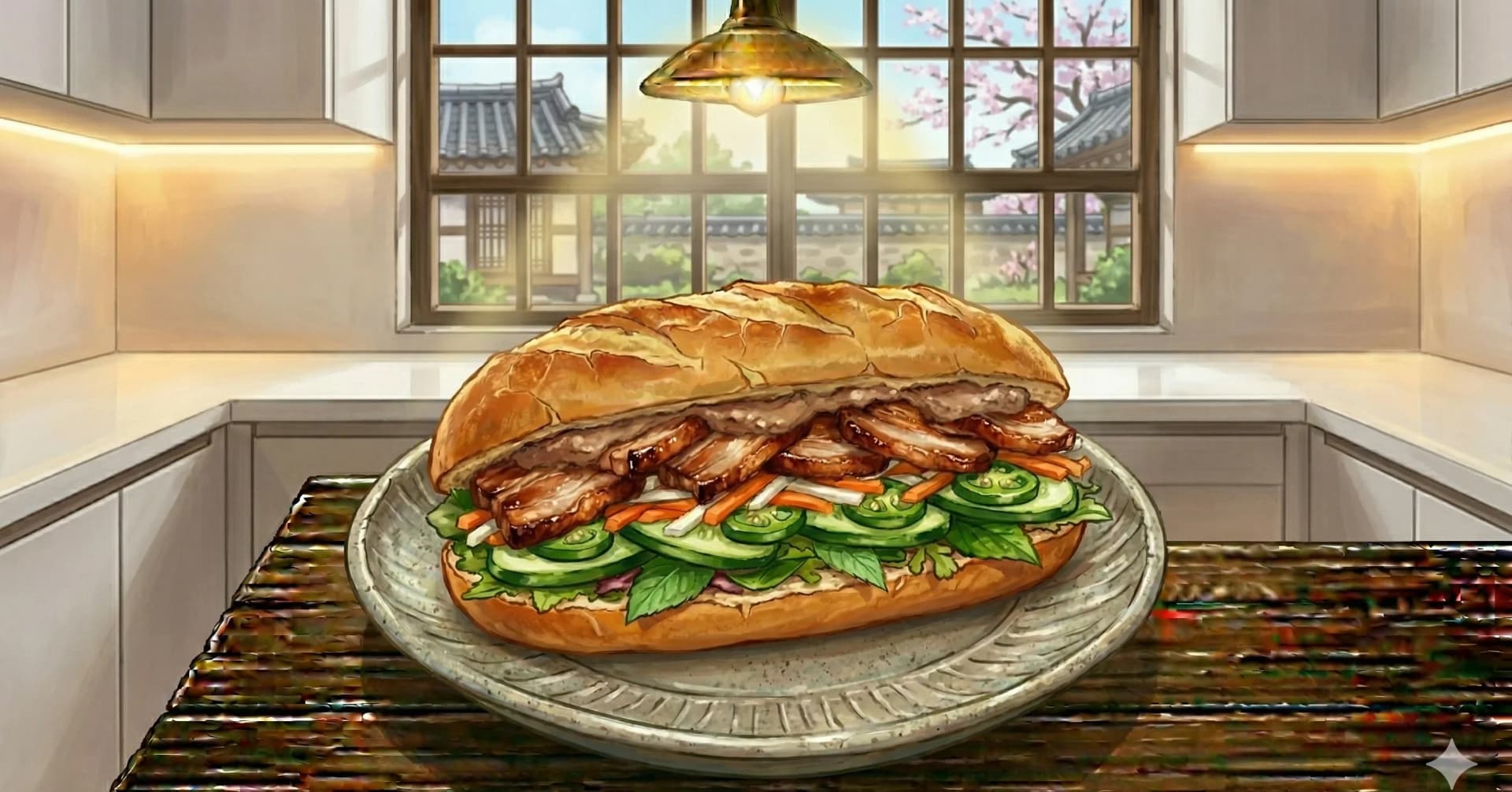
Vietnamese Cuisine
Banh Mi (Bánh Mì)
A crisp, airy baguette filled with seasoned pork, pickled daikon and carrot, cilantro, jalapeño, and pate
The first bite should crackle. A proper banh mi baguette has a crust so thin and crisp it shatters like a wafer, sending a shower of tiny flakes across your fingers and the wrapper below. Beneath that crust, the bread is almost impossibly light and airy, more cotton than crumb, leaving room for everything piled inside. And what is inside is a masterclass in contrast: rich, seasoned pork and a thin smear of savory pate against the sharp tang of quick-pickled daikon and carrot, the cool crunch of cucumber, the bright green punch of cilantro, and the slow heat of sliced jalapeño.
Banh mi is the product of a collision between French colonialism and Vietnamese ingenuity. The baguette arrived with the French, but Vietnamese bakers adapted it using a blend of wheat and rice flour that produces a lighter, crispier loaf than the dense, chewy French original. The fillings evolved from French charcuterie into something entirely Vietnamese, with cold cuts replaced by grilled or braised pork, French pate retained but made with local seasonings, butter swapped for mayonnaise (or both), and the whole thing layered with pickled vegetables and fresh herbs that no French sandwich would include.
The genius of banh mi is in its economy of effort relative to its complexity of flavor. Every component is simple on its own, but layered together they create a sandwich that hits every taste and texture: salty, sour, sweet, spicy, fatty, crunchy, soft, and fresh, all in a single handheld package. The pickled vegetables can be made ahead, the pork is versatile, and the assembly takes minutes. It is street food that translates perfectly to a home kitchen.
At a Glance
Yield
4 sandwiches
Prep
30 minutes (plus 1 hour for pickles)
Cook
20 minutes
Total
1 hour 50 minutes
Difficulty
Easy
Ingredients
Pickle Ingredients
- 5½ ozdaikon radish (about 1½–2 radishes), peeled and cut into thin matchsticks
- 5½ ozcarrot (about 2–2½ carrots), peeled and cut into thin matchsticks
- ½ cuprice vinegar or white vinegar
- ½ cupwarm water
- 4 tbspsugar
- 1 tspsalt
Pork Ingredients
- 1 lbpork shoulder or pork loin, sliced into thin pieces (about 5 mm thick)
- 1 tbspfish sauce
- 1 tbspsoy sauce
- 2⅓ tspsugar
- 2 clovesgarlic, minced
- 1/2 tspblack pepper
- 1 tbspneutral oil
To Assemble
Method
- 1
Make the pickled vegetables. Combine the vinegar, warm water, sugar, and salt in a bowl. Stir until the sugar and salt dissolve completely. Add the daikon and carrot matchsticks. Press them down so they are submerged. Let them pickle for at least 1 hour at room temperature. They will soften slightly, turn translucent, and develop a sweet-sour tang. The pickles keep in the refrigerator for up to 2 weeks.
- 2
Marinate the pork. Combine the sliced pork with the fish sauce, soy sauce, sugar, garlic, and black pepper in a bowl. Toss to coat evenly. Let it sit for at least 15 minutes while you prepare the other components.
- 3
Cook the pork. Heat the oil in a skillet over medium-high heat. When the oil shimmers, add the pork slices in a single layer, working in batches to avoid crowding. Cook for 2 to 3 minutes per side until the edges caramelize and the surface develops golden-brown spots. The fish sauce and sugar in the marinade will create a faintly sweet, savory crust. Set the cooked pork aside.
- 4
Warm the baguettes. Place them in a 180C (350F) oven for 3 to 5 minutes until the crust is crisp and shattery. If your baguettes are soft, this step is essential. A soggy baguette ruins a banh mi. The bread should crackle when you press it.
- 5
Split each baguette lengthwise, cutting about three-quarters of the way through so it hinges open. Pull out a small amount of the soft interior crumb to create a shallow trough. This makes room for the fillings without the sandwich being too bready.
- 6
Spread a thin layer of pate on one side of the bread and mayonnaise on the other. The pate should be a thin, even smear, not a thick slab. It provides background richness, not a dominant flavor.
- 7
Layer the pork slices inside the baguette. Add a handful of drained pickled daikon and carrot. Tuck in strips of cucumber, several sprigs of cilantro (stems included, they add crunch and flavor), and as many jalapeño slices as you like.
- 8
If using Maggi sauce, drizzle a few drops over the fillings. It adds a concentrated umami boost.
- 9
Press the sandwich gently closed. The first bite should produce a crackle from the crust, followed by the layered textures and flavors inside: the rich, savory pork, the creamy pate, the sharp pickled vegetables, the cool cucumber, the fragrant cilantro, and the slow-building jalapeño heat.
Key Ingredient Benefits
Daikon radish: A mild, white root vegetable common across East and Southeast Asian cuisines. It contains the digestive enzymes diastase and amylase, traditionally associated with aiding the digestion of starches and proteins. It also provides vitamin C and folate.
Cilantro: The stems and leaves provide different textures and intensities of the same flavor. The stems are crunchier and milder, the leaves more aromatic. Cilantro contains linalool and other terpenes that have been studied for antimicrobial and anti-anxiety properties in laboratory settings.
Fish sauce in the marinade: The glutamate in fish sauce enhances the perception of savoriness in the pork, making a simple pan-fried preparation taste more complex than its simplicity suggests.
Why This Works
The Vietnamese baguette is lighter and crispier than a traditional French baguette because it often includes rice flour or a higher hydration dough. This creates a thinner crust and a more open, airy crumb, which is structurally important. A dense baguette would overwhelm the fillings, but the Vietnamese version provides structure without competing for attention.
The do chua (pickled vegetables) serve a dual purpose. Their acidity cuts through the richness of the pork, pate, and mayonnaise, preventing the sandwich from feeling heavy. Their crunch adds textural contrast to the soft bread interior and the tender pork. The sweet-sour-salty brine also seasons the sandwich more evenly than salt alone could.
The thin smear of pate is the unifying layer that distinguishes a great banh mi from a merely good one. It adds a silky, umami-rich base note that ties the other flavors together, acting as a bridge between the savory pork and the bright, acidic pickles.
Substitutions & Variations
Protein options: Grilled chicken, thit nuong (grilled pork), lemongrass tofu, or cold cuts (Vietnamese cha lua/pork roll) all work. The pickled vegetables and herbs are the constants.
Pate: Chicken liver pate is traditional. If unavailable or disliked, extra mayonnaise mixed with a dash of fish sauce approximates the richness.
Bread: If Vietnamese baguettes are unavailable, use a French baguette with a very crisp, thin crust. Avoid soft sandwich rolls, which lack the crackle that defines the experience.
Vegetarian: Fill with lemongrass-marinated tofu or mushrooms, and use a vegetarian pate or hummus.
Banh mi op la: A breakfast variation served with a fried egg and pate inside the bread, sometimes with no pickles at all.
Serving Suggestions
Banh mi is a complete meal in itself, designed to be eaten out of hand. It is breakfast, lunch, or a late-night snack in Vietnam, sold from carts and small shop windows at any hour.
For a Vietnamese street food spread, serve alongside pho bo for the iconic pairing of broth and bread. The banh mi provides crunch and portability while the pho offers warmth and depth.
Banh mi also pairs well with a bowl of canh chua, the sweet and sour tamarind soup, for a light meal that covers a range of Vietnamese flavors.
Storage & Reheating
Pickled vegetables: Keep in a sealed jar in the refrigerator for up to 2 weeks. They improve after a day as the flavors develop.
Cooked pork: Refrigerate for up to 3 days. Reheat briefly in a skillet to restore the caramelized edges.
Assembled sandwich: Eat immediately. A banh mi does not store well once assembled, as the bread loses its crispness within an hour.
Bread: Baguettes are best on the day of purchase. Day-old baguettes can be refreshed by sprinkling with water and heating in a 180C oven for 5 minutes.
Cultural Notes
Bánh mì is one of the clearest examples of French colonial food becoming Vietnamese national food. The French baguette arrived in Vietnam during the colonial period (1858-1954) as a staple of the colonial administration's daily diet. Vietnamese bakers adapted it quickly. To stretch limited wheat supply, they cut the recipe with some rice flour, which produced a thinner crust and an airier crumb. The Vietnamese baguette that came out of that adjustment is a different bread than the French one. Lighter. Crispier. More delicate. That bread became the foundation of the modern bánh mì.
The sandwich itself came together in Saigon in the 1950s, after Vietnamese independence from France. The most widely cited origin credits the Hòa Mã shop in Saigon, founded in 1958 by Mr. Hòa and Mrs. Tịnh, who assembled the first recognizable modern bánh mì by stuffing a Vietnamese baguette with Vietnamese cold cuts, pâté (a colonial holdover), đồ chua (pickled daikon and carrot), cucumber, cilantro, jalapeño, and mayonnaise. French ingredients on one half, Vietnamese ingredients on the other. The sandwich was the post-colonial moment in food form.
The global rise of bánh mì has been a major success story for Vietnamese cuisine. Vietnamese refugees arriving in the United States after the fall of Saigon in 1975 opened bánh mì shops in Westminster, California (the heart of "Little Saigon"), Houston, and New Orleans, and the sandwich gradually moved into mainstream American food culture. Anthony Bourdain's documentary segments on Vietnamese street food in the 2000s did real work. Upscale Vietnamese restaurants in major Western cities did more. In 2011 the Oxford English Dictionary added "banh mi" as an English word.
Inside Vietnam, every region has its own version. Saigon's classic bánh mì thịt (cold cuts) is the most familiar abroad. Hue makes bánh mì bò kho with beef stew tucked inside. The central coast goes for bánh mì ốp la with a fried egg added in. The form is loose enough to absorb almost anything.
Nutrition Facts
Calories: 490kcal (25%)|Total Carbohydrates: 34.6g (13%)|Protein: 26.6g (53%)|Total Fat: 26.5g (34%)|Saturated Fat: 6.6g (33%)|Cholesterol: 87mg (29%)|Sodium: 1309mg (57%)|Dietary Fiber: 2.8g (10%)|Total Sugars: 19.7g
You Might Also Like
Ratings & Comments
Ratings & Comments
Ratings
Share your thoughts on this recipe.
Sign in to rate and comment