Thai Cuisine
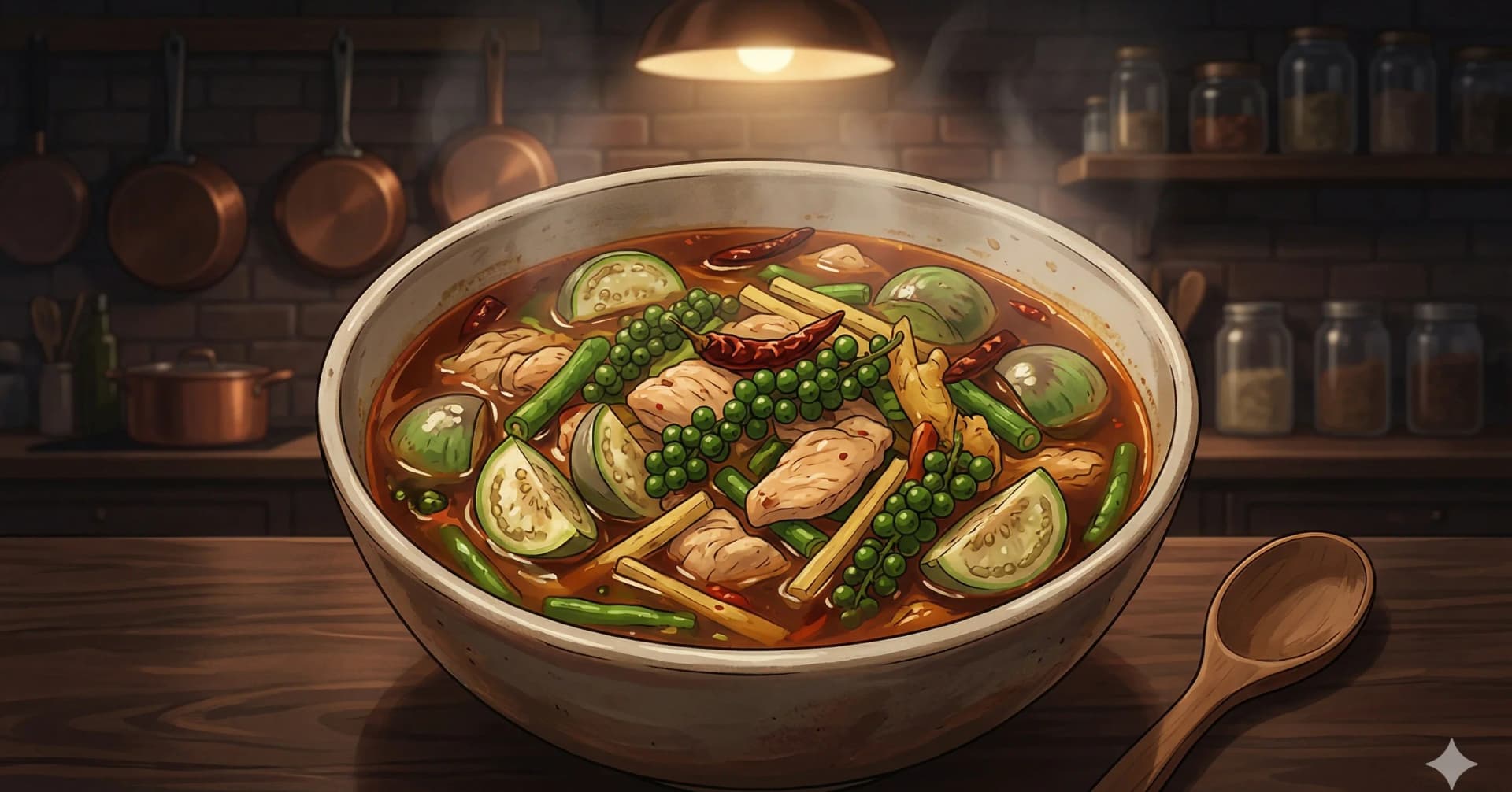
Gaeng Pa Gai (Thai Jungle Curry with Chicken)
A fiery, coconut-free Thai curry loaded with fresh herbs, fingerroot, and green peppercorns, built on a pounded paste of green chilies and dried spices
Gaeng pa translates to "forest curry" or "jungle curry," a name that tells you something about both its origins and its character. This is a curry born from the inland regions of Thailand, far from the coconut groves of the south, where cooks built intense broths from whatever herbs and vegetables they could pull from the forest floor. There is no coconut milk to soften the blow. The heat comes at you directly, carried in a thin, aromatic broth that tastes clean and almost medicinal in its complexity.
The paste at the heart of gaeng pa shares DNA with red curry and green curry, but the balance shifts. Fingerroot (krachai) takes a central role here, lending a cooling, almost camphor-like note you will not find in any other Thai curry. Green chilies bring a sharp, immediate heat that is brighter and more aggressive than the slow warmth of dried red chilies. Holy basil, the same herb that defines pad krapow, finishes the bowl with its peppery, clove-like fragrance.
Where a rich panang curry coats and comforts, jungle curry strips things down. It belongs to the same family of assertive, broth-forward Thai dishes as gaeng som and gaeng liang, soups that rely on herbs rather than fat for their depth. This version gives you two paths to the curry paste: a from-scratch method that rewards your patience with the truest flavor, and a quick-fix technique that doctors store-bought red curry paste into something close. Both produce a curry that is herbaceous, relentlessly spicy, and deeply satisfying with a bowl of steamed jasmine rice. Serve it the way they do in Thailand, hot enough to make you sweat, with a cold glass of water nearby.
At a Glance
Yield
4 servings
Prep
25 minutes
Cook
25 minutes
Total
50 minutes
Difficulty
Medium
Ingredients
Spice Paste Ingredients
- 3¼ tbspmild dried red chilies (such as guajillo or puya), stems and seeds removed
- 3to 5 fresh green Thai chilies, roughly chopped
- ⅞ tspcoarse sea salt
- ⅔ tspwhite peppercorns (about 1/4 teaspoon)
- ¾ ozlemongrass, bottom half only (about 1 stalk), thinly sliced
- ¼ ozgalangal, finely chopped
- ¾ ozfingerroot (krachai), finely chopped
- ¼ ozmakrut lime zest, finely chopped
- ¼ cupcilantro roots or stems, finely chopped
- 1 ozshallots (about 2 small), finely chopped
- 1¾ tbspgarlic (about 3 cloves), finely chopped
- ¼ ozfermented shrimp paste (gapi)
- 60to 75 ml red curry paste (Maeploy or Aroy-D recommended)
- 3to 5 fresh green Thai chilies, roughly chopped
- ¾ ozfingerroot (krachai), chopped
- ¾ ozlemongrass (about 1 stalk), thinly sliced
Curry Ingredients
- 2 tbspneutral oil (such as rice bran or sunflower)
- ¾ lbboneless, skinless chicken thighs, sliced into thin strips about 5 mm thick
- 2½ cupunsalted chicken stock
- 15to 30 ml fish sauce, divided
- 2⅓ tsppalm sugar, finely chopped (or light brown sugar)
- 4 ozlong beans, cut into 5 cm pieces (or green beans)
- 8baby corn, halved on the diagonal
- 4Thai eggplant (about 200 g), each cut into 4 to 6 wedges
- 2 sprigsyoung green peppercorns, cut into short segments (optional)
- 1 ozfingerroot (krachai), julienned (optional, for texture)
- 4to 5 makrut lime leaves, center stem removed, torn
- 3½ ozbamboo shoots, drained and sliced (optional)
- 1½ cupholy basil leaves
- 1large spur chili or 40 g red bell pepper, julienned
- ¾ oztoasted rice powder (see method note)
To Serve
- —Steamed jasmine rice
Method
- 1
If making the paste from scratch, toast the dried chilies in a dry skillet over medium heat, pressing them flat and turning once, until they darken a shade and become brittle. This takes about 2 minutes per side. Let them cool, then grind to a powder in a coffee grinder. Set aside.
- 2
In a heavy mortar, pound the green Thai chilies with the salt and white peppercorns until broken down to a rough paste. The salt acts as an abrasive and helps the chilies break apart faster. Add the lemongrass, galangal, fingerroot, makrut lime zest, and cilantro roots. Pound each addition until smooth before adding the next. The paste will gradually become wet and fragrant. Add the ground dried chilies and pound to incorporate. Add the shallots and garlic and pound until the paste is uniform with no visible chunks. Fold in the shrimp paste and pound briefly to combine. The finished paste should smell intensely herbaceous and look slightly coarse.
- 3
For the quick-fix paste, pound the green Thai chilies in the mortar until fine. Remove seeds and pith first if you want to moderate the heat. Add the fingerroot and lemongrass and continue pounding until you have a rough paste. Add the red curry paste and pound to combine. The mixture should smell bright and green from the fresh chilies layered over the deeper, roasted aroma of the commercial paste.
- 4
To make toasted rice powder, scatter 20 g uncooked jasmine rice in a dry skillet over medium-high heat. Stir constantly until every grain is a deep golden brown and the kitchen smells nutty and warm, about 3 to 4 minutes. Transfer to a plate to stop the cooking, let cool, then grind to a fine powder in a coffee grinder or mortar. Set aside.
- 5
Set a heavy-bottomed pot or wok over medium heat and add the oil. When the oil shimmers, add the curry paste and stir constantly. The paste will sizzle and the raw, sharp aroma will give way to something deeper and more rounded after about 2 minutes. The oil may start to pool at the edges of the paste, which tells you the aromatics have released their fat-soluble compounds.
- 6
Add the chicken strips and toss them through the paste so every piece picks up color. Let them cook in the paste for about 1 minute, stirring occasionally. The chicken does not need to cook through at this stage, just absorb the paste flavor.
- 7
Pour in the chicken stock. The liquid will deglaze the pot and the broth will turn a murky reddish-green. Add 15 ml of the fish sauce and the palm sugar, stir to dissolve, and bring to a gentle simmer. Cook for 12 to 15 minutes with the lid off. The chicken should be completely tender and the broth should taste well-seasoned and aromatic. Skim any foam that rises to the surface.
- 8
Add the long beans, baby corn, Thai eggplant, bamboo shoots if using, green peppercorns if using, julienned fingerroot if using, and the torn makrut lime leaves. Push the vegetables below the surface of the broth and simmer for 3 to 4 minutes. The beans should be tender but still have a snap, the eggplant should yield to a fork without collapsing, and the baby corn should be heated through. The green peppercorns will release a floral, peppery fragrance into the broth.
- 9
Turn off the heat. Stir in the holy basil, julienned spur chili or bell pepper, and toasted rice powder. The residual heat will wilt the basil in about 30 seconds, releasing its peppery, clove-like aroma. The rice powder will lightly thicken the broth and add a subtle toasted fragrance. Taste and adjust with more fish sauce if the broth needs depth or a pinch more sugar if the heat is overwhelming.
- 10
Ladle into bowls over steamed jasmine rice. Serve immediately while the broth is still steaming and the basil is freshly wilted.
Key Ingredient Benefits
Fingerroot (krachai): This slender rhizome looks like a bundle of brown fingers and tastes like a cross between ginger and mild white pepper with a cooling menthol finish. It is sold fresh at Southeast Asian markets, or more commonly, brined in glass jars labelled as "rhizome," "pickled galangal" (a misnomer), or by its Vietnamese name ngai bun. Brined fingerroot works well and keeps for months in the refrigerator. Fingerroot is traditionally used in Thai folk medicine for digestive complaints, and modern research has identified boesenbergin A and other compounds with potential anti-inflammatory activity.
Holy basil (bai krapao): Not the same as Thai sweet basil or Italian basil. Holy basil has serrated, slightly fuzzy leaves with a peppery, clove-like, almost spicy flavor. It wilts quickly once picked and does not store well, so use it the same day if possible. In Ayurvedic medicine, holy basil (tulsi) is classified as an adaptogen. In Thai cooking, it appears in stir-fries and curries where its assertive flavor can stand up to high heat and strong seasonings.
Green peppercorns: These are fresh, unripe peppercorns still attached to their stems. They have a milder, more floral heat than dried black pepper and release a pleasant pop when bitten. Available fresh at Southeast Asian markets or brined in jars. The brined version is a reliable year-round option. Green peppercorns contain piperine, the same compound responsible for black pepper's heat, though in lower concentrations.
Toasted rice powder (khao khua): Made by toasting raw jasmine or sticky rice until deep brown, then grinding to a powder. It adds body and a distinctive roasted grain flavor. It appears across Isaan cuisine, particularly in laab and nam tok. Prepare it fresh for the best aroma; pre-ground powder loses its fragrance within a few days.
Fish sauce: The primary salt seasoning in this curry. Quality matters enormously. Squid brand, Megachef, and Red Boat are reliable choices. Fish sauce is high in sodium but rich in free glutamates from the fermentation process, providing an umami backbone that salt alone cannot achieve.
Shrimp paste (gapi): A dense, pungent paste of fermented shrimp that smells overwhelming raw but transforms into a deep savory note when cooked. It is the umami foundation of the from-scratch paste and one of the reasons homemade paste tastes more complex than most commercial versions. A little goes a long way.
Why This Works
Jungle curry relies on water or stock rather than coconut milk, which changes the entire dynamic of how flavor is built. In coconut-based curries like green curry, the fat in coconut milk carries and rounds out the aromatic compounds from the paste. Without that fat, every element in gaeng pa has to work harder. The paste must be more concentrated, the herbs more abundant, and the seasoning more precise because there is nothing to hide behind.
Frying the curry paste in oil before adding liquid is essential. This step blooms the fat-soluble flavor compounds in the dried chilies, lemongrass, and galangal, the same principle behind tempering spices in Indian cooking. Without this step, the paste tastes raw and one-dimensional even after simmering.
Fingerroot is the ingredient that sets jungle curry apart from every other Thai curry. Its cooling, herbal quality, somewhere between ginger and mild eucalyptus, creates a flavor signature that cannot be replicated with other aromatics. Using it twice, pounded into the paste and julienned into the simmering broth, gives you both its deep background flavor and its brighter, more immediate character.
Toasted rice powder is a technique borrowed from the Isaan tradition of laab and nam tok. In jungle curry, it serves double duty: the starch provides a very slight body to the thin broth, and the toasted grain adds a nutty warmth that bridges the gap between the sharp paste and the savory stock.
Substitutions & Variations
Protein: Jungle curry is traditionally made with whatever protein is available, including wild boar, catfish, frog, or mixed offal. For home cooking, pork loin (sliced thin, same cooking time as chicken), shrimp (add in the last 3 minutes), firm tofu (press for 20 minutes, then cube), or mixed mushrooms all work well. Adjust the stock to match: pork stock for pork, vegetable stock for tofu.
Fingerroot: If unavailable, substitute equal parts fresh ginger and a small amount of lemongrass. The flavor will not be the same, but the curry will still be good. Do not omit it entirely if you can help it, as it is the defining herb of gaeng pa.
Holy basil: Thai sweet basil is the closest substitute, though it lacks the peppery bite. Italian basil is a distant third. If using Thai basil, add a few extra cracks of black pepper to compensate.
Vegetables: Pea eggplant (small green spheres with a slightly bitter pop) are a very traditional addition. Bamboo shoots, straw mushrooms, and wing beans are common in regional versions. Cauliflower, Chinese broccoli, or zucchini work as Western-market substitutes.
Heat level: For a milder curry, remove all seeds and pith from the green chilies before pounding, and reduce the quantity by half. For a more aggressive version, leave the seeds in and increase to 8 to 10 green Thai chilies.
Vegetarian or vegan: Replace fish sauce with soy sauce or mushroom sauce (about 20 ml). Replace shrimp paste with 10 g white miso. Use vegetable stock and firm tofu or a mix of mushrooms and eggplant.
Quick-fix paste brand note: Maeploy and Aroy-D produce the most reliable red curry pastes for this technique. Avoid brands marketed primarily to Western audiences (such as Thai Kitchen), as they tend to be significantly milder and less aromatic.
Serving Suggestions
Steamed jasmine rice is the only essential companion. The plain, slightly sweet rice absorbs the thin, fiery broth and gives the palate somewhere to rest between bites. In Thailand, jungle curry is often part of a multi-dish spread where its lean intensity plays against richer preparations. Pair it with green curry or red curry for a side-by-side study in how coconut milk transforms a Thai curry, or serve it alongside tom yum goong if you want a meal built entirely around bright, herbaceous heat. A cooling plate of sliced cucumber and raw long beans on the side is traditional and practical. For a complete Thai table, pad krapow shares the holy basil connection, while gaeng som offers another coconut-free broth in a sour rather than spicy direction. If feeding a crowd, a platter of gai yang and a bowl of sticky rice round out the spread. For a lighter warm-weather meal, gaeng liang and jungle curry together create a vegetable-forward, broth-based dinner that feels restorative rather than heavy.
Storage & Reheating
Refrigerator: Store in an airtight container for up to 4 days. The broth may gel slightly as the chicken stock cools, which is normal and a sign of good stock. The flavor intensifies overnight as the herbs continue to steep. Keep rice separate.
Reheating: Warm gently in a saucepan over medium-low heat until the broth reaches a simmer. Add a splash of water or stock if the liquid has reduced. The Thai eggplant will soften further, which is acceptable but not ideal. Add a few fresh holy basil leaves just before serving to refresh the aroma.
Freezing: The curry freezes well for up to 2 months without the finishing herbs. The eggplant and long beans will soften upon thawing, so consider slightly undercooking the vegetables if you plan to freeze a batch. Thaw overnight in the refrigerator and reheat on the stovetop. Stir in fresh holy basil and a squeeze of lime after reheating to revive the brightness.
Cultural Notes
Gaeng pa (แกงป่า, "jungle curry") is the Thai curry without coconut milk, and that single omission shapes everything else about the dish. Where most Thai curries are softened and rounded by coconut, jungle curry runs straight: a thin, fiery, herbaceous broth built on a red-curry paste fried in oil rather than coconut cream, then thinned with water or stock and seasoned with fish sauce and palm sugar. The result is a curry that is hotter, leaner, and more aromatic than its coconut-milk-based cousins, with the herbs and spices coming through unmuted.
The dish belongs to the rural and upland cooking traditions of northern and northeastern Thailand, where coconut palms historically grew poorly and where wild forest ingredients (game meat, freshwater fish, wild herbs, krachai fingerroot, young green peppercorns on the stem) were the available pantry. The name gaeng pa translates literally as "forest curry" or "jungle curry," reflecting both the wild-foraged ingredients and the dish's association with countryside cooking. Modern preparations substitute chicken, pork, or freshwater fish for the wild game, but the broader profile (intensely spiced, no coconut, packed with assertive herbs) stays consistent.
The signature aromatics distinguish the dish from other Thai curries. Krachai (Boesenbergia rotunda, sometimes called fingerroot or Chinese keys) is the defining note, contributing a sharper, more medicinal-camphor flavor than ginger or galangal. Green peppercorns on the stem (prik thai on) add a fresh, bright pepper bite that dried peppercorns cannot match. Whole kaffir lime leaves, sweet basil, and dried chilies round out the herb mix. The dish is typically served with steamed rice and is one of the spicier preparations on a standard Thai menu, with diners often warned by servers before ordering.
Nutrition Facts
Calories: 346kcal (17%)|Total Carbohydrates: 29g (11%)|Protein: 25.9g (52%)|Total Fat: 14.8g (19%)|Saturated Fat: 3.4g (17%)|Cholesterol: 92mg (31%)|Sodium: 1626mg (71%)|Dietary Fiber: 6.2g (22%)|Total Sugars: 7.6g
You Might Also Like
Ratings & Comments
Ratings & Comments
Ratings
Share your thoughts on this recipe.
Sign in to rate and comment