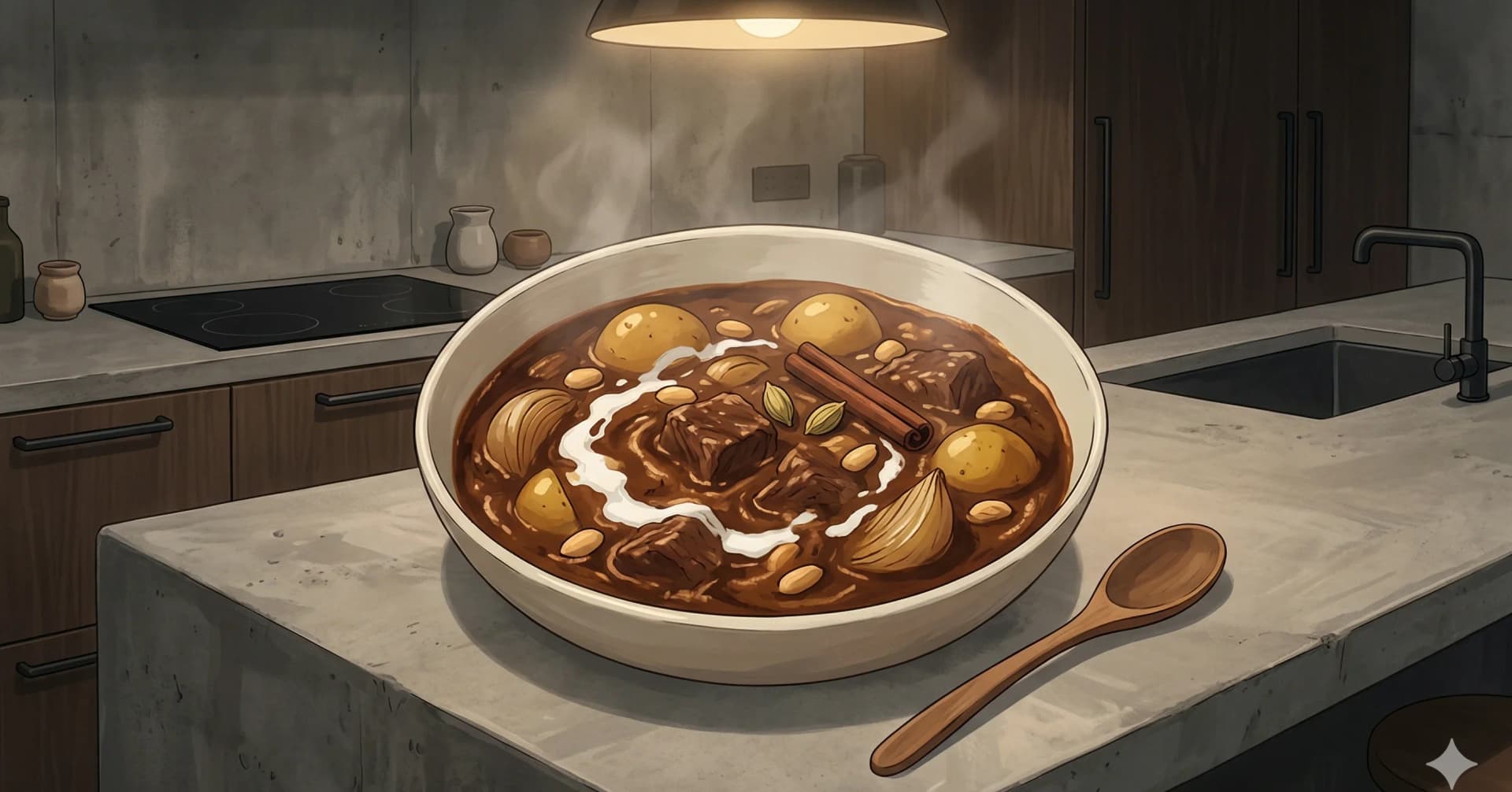
Thai Cuisine
Massaman Curry (Gaeng Massaman)
A thick, aromatic Thai curry of braised chicken, tender potatoes, and roasted peanuts in spiced coconut milk with cinnamon, cardamom, and tamarind
The first thing you notice is the smell. Not the sharp green punch of a green curry or the bright chili heat of a red curry, but something warmer, rounder, almost sweet. Cinnamon and cardamom rise from the pot alongside coconut milk and toasted cumin, and for a moment you could be standing between a Thai kitchen and a spice market somewhere along the old trade routes between India and Southeast Asia.
Massaman curry is believed to have arrived in Thailand through contact with Muslim traders and the Malay communities in the south. The name likely derives from "Musulman," the Persian word for Muslim. This origin explains its distinctiveness within Thai cuisine: the heavy use of dry spices like cinnamon, cloves, and cardamom, the presence of potatoes (otherwise rare in Thai cooking), and the traditional avoidance of pork. It is a dish born of cultural exchange, and it carries the fingerprints of Indian, Malay, and Thai kitchens equally.
What the dish delivers is richness without heaviness. The coconut milk braising liquid reduces into a thick, golden sauce that coats each piece of chicken. Potatoes absorb the spiced liquid and become creamy through. Roasted peanuts add crunch and a toasty sweetness. Tamarind provides just enough acidity to keep the richness from becoming cloying, and the balance of sweet, salty, and sour is what separates good massaman from forgettable versions.
The single most useful technique here is building a quick spice paste from store-bought red curry paste. Commercial massaman pastes cut costs by skimping on the dry spices that define the dish. By toasting whole cumin, coriander, cloves, and cardamom yourself and folding them into a good red curry paste, you get a result that tastes fully homemade in a fraction of the time.
At a Glance
Yield
4 servings
Prep
25 minutes
Cook
60 minutes
Total
1 hour 25 minutes
Difficulty
Medium
Ingredients
Spice Paste Ingredients
Curry Ingredients
- 2¼ lbbone-in, skin-on chicken thighs and drumsticks (about 4–6 pieces), excess fat trimmed
- 2⅛ cupfull-fat coconut milk, divided
- 1 tbspvegetable oil (for browning, optional)
- 2¾ tbsppalm sugar, finely chopped (or light brown sugar)
- 30to 45 ml fish sauce
- 15to 30 ml tamarind paste (store-bought concentrate)
- 2bay leaves
- 1star anise (optional, adds a gentle licorice warmth)
- 1cinnamon quill (optional, for extra depth)
- ¾ lbwaxy or all-purpose potatoes (such as Yukon Gold) (about 2 potatoes), peeled and cut into 2.5 cm chunks
- 5½ ozyellow or white onion (about half a large onion) (about 1 onion), cut into 1 cm wedges
- 1¼ ozunsalted roasted peanuts, plus more for garnish
- —Water as needed
To Serve
- —Steamed jasmine rice
Method
- 1
Toast the cumin seeds in a small dry skillet over medium-high heat, stirring constantly, until they darken a shade and release a warm, earthy scent, about 1 to 2 minutes. Transfer to a small bowl immediately so they do not continue to cook.
- 2
Add the coriander seeds, cloves, and cardamom pods to the same skillet. Toast over medium-high heat, moving them constantly, until the coriander seeds turn a shade darker and the kitchen fills with a complex, floral aroma, about 1 to 2 minutes. Transfer to the bowl with the cumin.
- 3
Grind all the toasted spices to a fine powder in a mortar and pestle or spice grinder. Add the ground cinnamon and nutmeg. If using a mortar, add the red curry paste and shrimp paste and pound until well combined. If using a grinder, transfer the spice powder to a small bowl and stir in the curry paste and shrimp paste with a spoon until evenly blended. Set aside.
- 4
If you want deeper flavor, brown the chicken first. Heat the oil in a heavy-bottomed pot or Dutch oven over medium-high heat. Place the chicken skin-side down in a single layer without crowding. Let it sear undisturbed for about 4 minutes until the skin is golden and releases easily from the pot. Turn and sear the other side briefly. Remove to a plate and repeat with remaining pieces. Pour off the excess fat from the pot, but leave the browned bits on the bottom. If you prefer to skip this step, proceed directly to the next one.
- 5
Add about 125 ml of the coconut milk to the pot and bring to a simmer over medium heat, scraping up any browned bits from the bottom. Add the curry paste and stir to dissolve it into the coconut milk. Cook for 3 to 4 minutes, stirring frequently, until the mixture thickens and you see the oil begin to separate and pool around the edges of the paste. The color will deepen to a rich, rusty orange. If the oil does not separate after 4 minutes, some coconut milks are processed to prevent this, so move on.
- 6
Pour in the remaining coconut milk and stir until the sauce is smooth and uniform. Add the palm sugar, half of the fish sauce, and half of the tamarind paste. Drop in the bay leaves (tear them in half first to release more fragrance), and the star anise and cinnamon quill if using. Stir to combine.
- 7
Nestle the chicken pieces into the sauce along with any juices that collected on the plate. The chicken should be nearly submerged. If not, add a splash of water to bring the liquid level up. Bring to a gentle simmer, then reduce the heat to low. Partially cover the pot and cook for 35 minutes. The sauce should barely bubble. Check once or twice to make sure the heat is not too high.
- 8
After 35 minutes, the chicken should be nearly tender but not yet falling off the bone. A layer of orange-tinted coconut oil will float on the surface, which is the traditional look of massaman. Skim some off if you prefer a leaner sauce, but a moderate amount of oil on top is desirable. Add the potatoes, onion wedges, and half of the peanuts. Push the potatoes down so they are just submerged. If the liquid does not cover them, add water in small increments until it does. The onions will wilt down on their own.
- 9
Raise the heat slightly and simmer uncovered for 10 to 15 minutes until the potatoes slide easily off a fork with no resistance. The sauce will have thickened further during this time.
- 10
Turn off the heat. Taste the sauce carefully. It should taste strongly seasoned, sweet and savory with a gentle sourness from the tamarind cutting through the coconut richness. Add more fish sauce for salt, more tamarind for brightness, or a pinch more sugar if needed. Remember it will be served over plain rice, so season it a little more intensely than you might eat on its own. Remove the bay leaves, star anise, and cinnamon quill if you used them.
- 11
Ladle the curry into bowls over jasmine rice. Scatter the remaining peanuts over the top and serve immediately.
Key Ingredient Benefits
Coconut milk: Full-fat coconut milk is essential here. The fat carries flavor compounds from the spices and creates the rich, creamy body that defines the dish. Coconut milk contains lauric acid, a medium-chain fatty acid that is metabolized differently from long-chain fats. It is calorie-dense at roughly 200 calories per 240 ml, so the portion served over rice keeps the amount reasonable. Shake the can well before opening, or scoop the thick cream from the top for the initial paste-frying step.
Tamarind paste: Tamarind provides the sour element in the sweet-salty-sour balance that anchors Thai seasoning. It contains tartaric acid, which gives it a distinct fruity sourness different from vinegar or citrus. Traditional Thai cooking uses paste made from pulp, but store-bought concentrate works well. A small amount prevents the curry from tasting heavy or one-note. See also how tamarind functions in pad thai, where it plays a similarly essential balancing role.
Cardamom: Green cardamom, used in this paste, contains cineole and alpha-terpinyl acetate, compounds that give it its distinctive eucalyptus-like warmth. In traditional Thai and Ayurvedic medicine, cardamom is regarded as a digestive aid. White cardamom, more common in Thailand, is milder but interchangeable here. See the cardamom ingredient guide.
Peanuts: Roasted peanuts add protein (about 7 g per 30 g serving), healthy monounsaturated fats, and resveratrol, the same antioxidant compound found in red wine. Toasting your own from raw peanuts produces a fresher, more complex flavor than pre-roasted.
Why This Works
The quick semi-homemade paste is the key technique here. Store-bought red curry paste already contains the lemongrass, galangal, garlic, shallots, and chilies that form the foundation of any Thai curry. What it lacks for massaman are the dry spices. By toasting whole seeds yourself and grinding them fresh, you get vastly more aromatic power than any pre-made massaman paste provides. Commercial massaman pastes use minimal quantities of expensive spices to keep costs down. Your homemade blend has no such limitation.
Browning the chicken before braising creates fond, the caramelized proteins stuck to the bottom of the pot, which dissolves into the sauce and adds savory depth that unbrowned chicken cannot provide. This step is borrowed from RecipeTinEats' approach, where the beef braising liquid is separately reduced and folded back into the curry for maximum concentration of flavor.
Cooking the curry paste in a small amount of coconut milk before adding the rest serves two purposes. First, the fat in the coconut cream extracts fat-soluble flavor compounds from the paste. Second, cooking the paste until the oil separates removes the raw taste of the aromatics and develops a rounder, more complex flavor. If you skip this step and dump everything in at once, the curry will taste flat and one-dimensional by comparison.
The star anise, drawn from the RecipeTinEats version, is not traditional in every massaman recipe but adds a subtle sweetness and warmth that harmonizes with the cinnamon and cardamom. A single pod is enough. More would push the flavor toward Chinese five-spice territory.
Substitutions & Variations
Protein: Beef chuck is the other classic choice and produces a richer, more robust curry. Cut it into 4 cm cubes and braise for 1.5 to 2 hours in the coconut sauce (or separately in beef broth with lemongrass trimmings, as in the RecipeTinEats approach) until fork-tender before adding the potatoes. Lamb shoulder or goat work beautifully and are traditional in Muslim-Thai cooking. For a quicker version, boneless skinless chicken thighs will be tender in about 20 minutes but will not contribute as much body to the sauce.
Potatoes: Waxy varieties hold their shape best. Sweet potatoes (yellow-fleshed, not orange yams) are a popular variation and add natural sweetness. Cut them slightly larger as they soften faster than regular potatoes.
Curry paste: If you cannot find red curry paste, a store-bought massaman paste will work. Use about 75 to 90 ml and skip making the spice blend. Maeploy, Aroy-D, and Maesri are reliable brands. Maesri, sold in small cans, is a favorite among Thai restaurant kitchens.
Vegan version: Replace the chicken with firm tofu (press it first and brown the cubes) or chunks of kabocha squash. Use soy sauce or mushroom sauce in place of fish sauce, and omit the shrimp paste. The coconut milk and spices carry enough flavor to make this satisfying without animal protein.
Extra aromatics: The RecipeTinEats version chars garlic, shallots, and galangal in a dry skillet before blending to build a smoky undertone. If you are making the paste entirely from scratch rather than using the semi-homemade method, this charring step adds genuine complexity. A single star anise and a cinnamon quill dropped into the sauce alongside the bay leaves deepen the spice layers without any additional work.
Serving Suggestions
Massaman curry is a complete one-pot meal over jasmine rice and needs very little alongside it. If you are building a Thai spread, pair it with dishes that offer contrast in temperature, texture, and flavor profile. A plate of gai yang (grilled chicken) brings smoky char. A bowl of tom kha gai served as a starter offers a lighter, brighter coconut and galangal broth that sets up the palate for the richer curry to follow. Pad thai provides a sweet-sour noodle counterpoint, while khao soi makes a Northern Thai pairing if you want to compare two coconut-curry traditions side by side. A simple cucumber salad dressed with rice vinegar, sugar, and sliced shallots is the easiest accompaniment and cuts through the richness effectively. For a full curry table, set massaman alongside a panang curry and a green curry with steamed rice in the center and let everyone serve themselves.
Storage & Reheating
Advance preparation: Massaman curry improves overnight. The potatoes absorb more sauce, the spices meld further, and the flavors deepen. Making it a day ahead is recommended if time allows.
Refrigerator: Store in an airtight container for up to 5 days. The coconut fat will solidify on the surface when chilled, which is normal. It melts back into the sauce on reheating.
Reheating: Warm gently on the stovetop over medium-low heat, stirring occasionally. Add a splash of water or coconut milk if the sauce has thickened too much. Remove the potatoes first if reheating for an extended time, as they can fall apart. Add them back in the last few minutes. Microwave reheating works in a pinch. Stir halfway through and heat in shorter intervals to avoid uneven hot spots.
Freezing: The curry freezes well for up to 3 months. The potatoes will soften slightly on thawing but remain acceptable. For best results, freeze the sauce and chicken without the potatoes, then cook fresh potatoes when you reheat. Thaw overnight in the refrigerator before reheating on the stovetop.
Curry paste: The spice paste can be made ahead and frozen in portions. It keeps for up to 6 months in the freezer and thaws quickly at room temperature.
Cultural Notes
Massaman curry (แกงมัสมั่น, gaeng massaman) is the Thai curry with the most foreign roots, and its history maps neatly onto centuries of contact between Thailand and the Muslim trading world. The name is widely accepted to derive from "Mussulman," a 17th-century English and Persian term for Muslim. The curry's defining spices, cardamom, cinnamon, star anise, cloves, cumin, and bay leaf, are uncommon in other Thai curries and point to influence from Persian, Indian Muslim, and Malay traders who reached Thai ports beginning in the Ayutthaya period (1351 to 1767). Most Thai food historians place the dish's origins in the Muslim communities of southern Thailand and the royal court of Ayutthaya, where Persian merchants held influential positions.
The curry is gentler in chili heat than most Thai curries but heavier in spice and richer in coconut milk. The paste is built from dried red chilies, shallots, garlic, lemongrass, galangal, and the same warming spices used in Persian and Indian cooking, all pounded and then fried in coconut cream before the meat and remaining liquid go in. Beef is the most traditional protein, paired with potatoes, onions, peanuts, and palm sugar; tamarind paste adds the sour note that ties the spice and sweetness together. Lamb and chicken versions are also common, and a vegetarian preparation with squash and tofu has spread through modern Thai restaurants worldwide.
In 2011, a CNN Travel readers' poll named massaman curry the world's most delicious food, beating out hundreds of other dishes from cuisines worldwide. The ranking generated significant Thai national pride and led to a noticeable increase in international Thai restaurant interest in the dish. Within Thailand itself, massaman is most associated with the southern provinces of Yala, Pattani, Narathiwat, and Satun, where the Muslim population is highest, and with the historical city of Ayutthaya. The dish appears most often at family meals and special occasion dinners rather than as a street food, since the long simmer needed to tenderize the meat and develop the spice depth does not lend itself to quick-fire wok cooking.
Nutrition Facts
Calories: 958kcal (48%)|Total Carbohydrates: 41.8g (15%)|Protein: 63.9g (128%)|Total Fat: 62.2g (80%)|Saturated Fat: 34.3g (172%)|Cholesterol: 264mg (88%)|Sodium: 1406mg (61%)|Dietary Fiber: 8.6g (31%)|Total Sugars: 17.5g
You Might Also Like
 Easy
EasyVietnamese Cuisine
Ga Kho Gung (Vietnamese Caramelized Ginger Chicken)
1 hour
 Easy
EasyVietnamese Cuisine
Cháo Gà (Vietnamese Chicken Rice Porridge)
1 hour 30 minutes
 Easy
EasyIndonesian Cuisine
Bubur Ayam (Indonesian Chicken Rice Porridge)
1 hour 10 minutes
 Medium
Thai Cuisine
Boat Noodles (ก๋วยเตี๋ยวเรือ)
3 hours 15 minutes
Ratings & Comments
Ratings & Comments
Ratings
Share your thoughts on this recipe.
Sign in to rate and comment