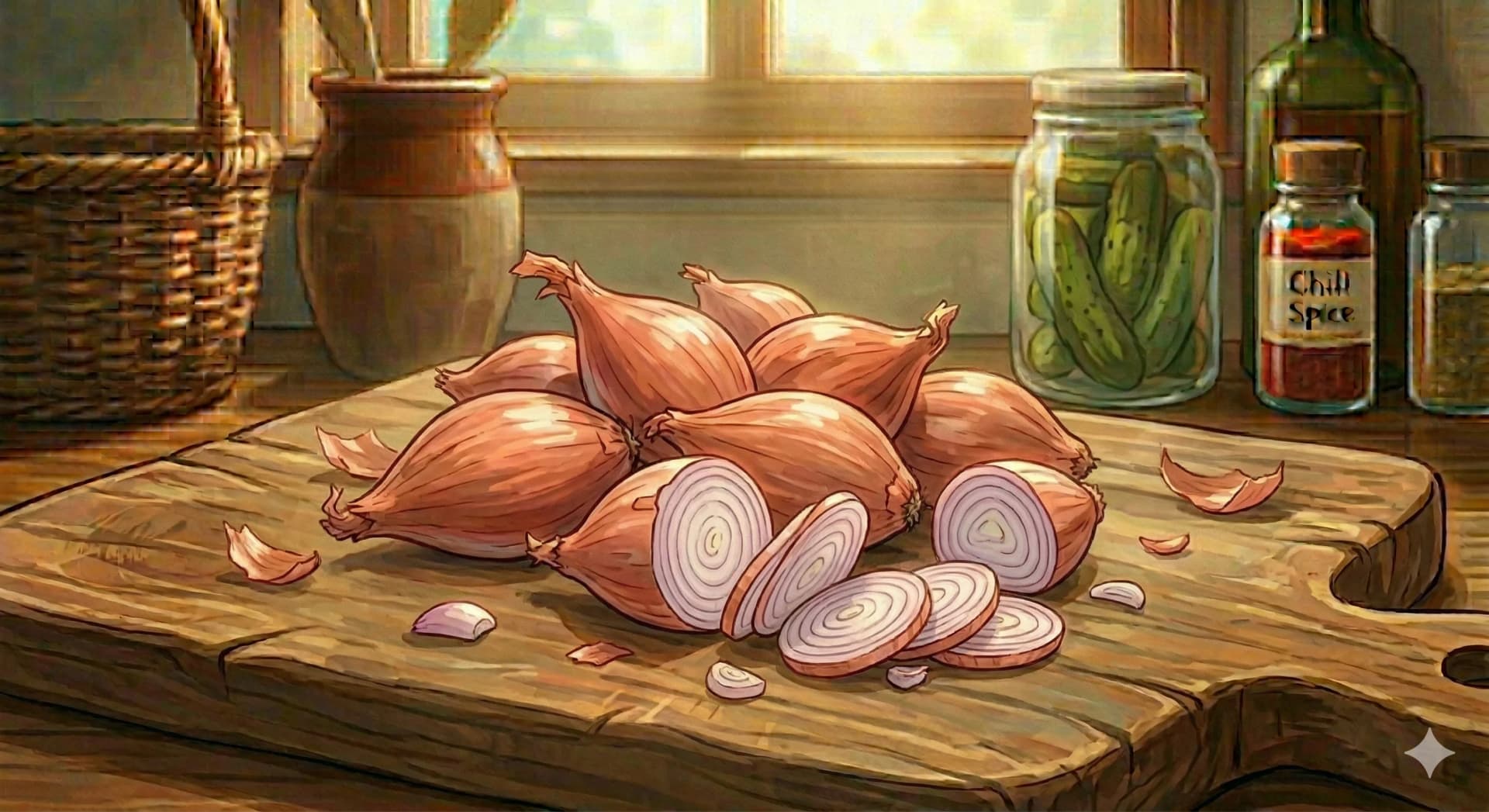
Shallots
Also known as: Xiao Cong, Asian Shallots, Allium cepa var. aggregatum, French Shallots
Shallots occupy a specific niche in Chinese cooking — sweeter and more delicate than onions, more complex than scallions, they are used both as a fresh aromatic and, when fried until crispy, as one of the great condiments of Southeast Asian and southern Chinese cooking.
Crispy fried shallots (zha cong su) scattered over noodle soups, congee, and braised dishes add texture, sweetness, and a deep, caramelized onion flavor that transforms even the simplest preparation.
Key facts at a glance:
- Sweeter and more delicate than onions — occupies a unique niche as both fresh aromatic and fried condiment
- Crispy fried shallots (zha cong su) — one of the great finishing condiments of Southeast Asian and southern Chinese cooking
- Asian shallots differ from European — more pungent and less watery than Western varieties
- Shallot oil — a foundational flavoring in Shanghainese cooking
- Highest antioxidant content among alliums — rich in quercetin and flavonoids
Flavor Profile
Origin
Central Asia (origin), Southern China, Southeast Asia
Traditional Medicine Perspectives
Traditional Chinese Medicine
Shallots share the TCM profile of other alliums — warm, acrid, and associated with the Lung and Stomach meridians. They are used to release the exterior, warm the middle, and move Qi. Shallots are considered gentler and more tonifying than garlic, making them suitable for people with more sensitive constitutions who need warming without excessive stimulation.
Modern Scientific Research
Shallots contain high concentrations of quercetin and other flavonoids — research indicates shallots have among the highest antioxidant content of any allium.
They contain allicin precursors similar to garlic and onions, with associated antimicrobial and anti-inflammatory properties.
The caramelization that occurs during frying creates additional antioxidant Maillard reaction products.
Cultural History
Shallots have been cultivated across Asia for millennia and are particularly important in the cooking of southern China, Vietnam, Thailand, Malaysia, and Indonesia.
In Cantonese and Teochew cooking, fried shallots are a finishing condiment used with the same casual confidence as black pepper in a Western kitchen. In Shanghainese cooking, shallot-infused oil is a foundational flavoring.
The small, elongated Asian shallot — more pungent and less watery than European varieties — is the preferred type across Chinese and Southeast Asian cuisines.
Culinary Uses
Use raw in dressings and cold preparations where a milder onion flavor is wanted.
Slice thinly and fry until crispy for a finishing garnish over noodles, congee, and braised dishes. Use in aromatics bases for Cantonese and Shanghainese preparations.
Crispy fried shallots add texture, sweetness, and deep caramelized flavor to even the simplest preparation.
Infuse in oil for shallot oil. Use in Vietnamese and Southeast Asian preparations.
Preparation Methods
For crispy fried shallots: slice thinly and evenly (a mandoline helps). Start in cold oil, bring to medium heat, and fry slowly until deep golden — this produces crispy results without burning.
Drain on paper towels; they crisp further as they cool. Store in an airtight container for up to a week.
Traditional Dishes
- Cantonese congee (as garnish)
- Shanghainese scallion oil noodles
- Hainanese chicken rice
- Vietnamese pho (as garnish)
- Braised duck
- Kerala Beef Masala
Recipes Using Shallots
- Grilled Lemongrass Pork (Thịt Nướng)
- Ayam Goreng Lengkuas (Galangal Fried Chicken)
- Grilled Pork Noodle Bowl (Bún Thịt Nướng)
- Broken Rice Plate (Cơm Tấm)
- Steamed Rice Rolls (Bánh Cuốn)
- Bubur Ayam (Indonesian Chicken Rice Porridge)
- Carrot and Cabbage Thoran
- Ga Kho Gung (Vietnamese Caramelized Ginger Chicken)
- Turmeric Coconut Chicken (Gulai Ayam)
- Gaeng Pa Gai (Thai Jungle Curry with Chicken)
- Gaeng Liang (Thai Vegetable Soup with Shrimp Paste and Basil)
- Opor Ayam (Javanese Chicken in Coconut Milk)
- Kerala Beef Masala
- Hanoi Noodle Soup (Bún Thang)
- Ayam Bakar (Indonesian Grilled Chicken)
- Ayam Percik (Malaysian Flame-Grilled Coconut Chicken)
- Beef Rendang (Rendang Daging)
- Chicken Rendang (Rendang Ayam)
- Ikan Bakar (Malaysian Grilled Fish in Banana Leaves)
- Caramelized Fish in Clay Pot (Cá Kho Tộ)
- Pad Thai (ผัดไทย)
- Bo Kho (Vietnamese Beef Stew)
- Glass Noodle Salad (Yum Woon Sen / ยำวุ้นเส้น)
- Blue Rice Herb Salad (Nasi Kerabu)
- Khao Soi Gai (ข้าวซอย)
- Nam Prik Ong (Northern Thai Pork and Tomato Dip)
- Panang Curry
- Sayur Asem (Indonesian Tamarind Vegetable Soup)
- Black Nut Beef Soup (Rawon)
- Vegetable Coconut Stew (Sayur Lodeh)
- Caramelized Pork & Eggs (Thịt Kho Tàu)
- Jakarta Creamy Beef Soup (Soto Betawi)
- Thai Sour Curry (Gaeng Som)
- Fried Spring Rolls (Chả Giò)
- Banana Leaf Steamed Fish (Pepes Ikan)
- Noodles in Sweet Gravy (Mee Rebus)
- Hainanese Chicken Rice
- Nasi Lemak
Comments
Share your thoughts on this ingredient.
Sign in to comment0 Comments