Korean Cuisine
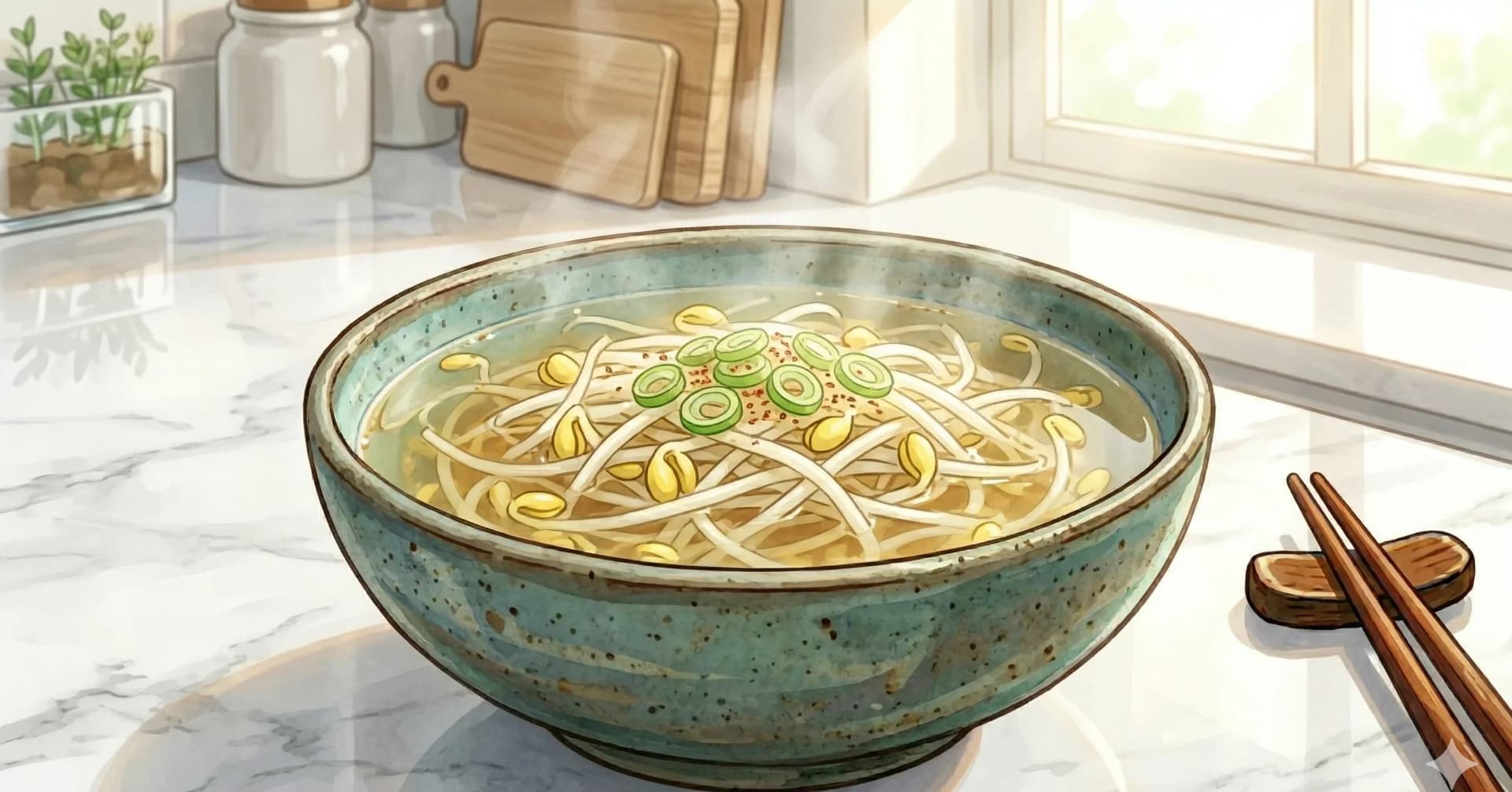
Kongnamul Guk (Soybean Sprout Soup)
A light, clean Korean soup of soybean sprouts in anchovy broth, ready in fifteen minutes
If Korean soups were a family, kongnamul guk would be the quiet, dependable one who shows up every day without fanfare. It is not dramatic like yukgaejang or rich like galbitang. It is just reliably good, reliably easy, and reliably present on Korean dinner tables several times a week.
The soup is built on two things: soybean sprouts and anchovy broth. The sprouts contribute a clean, faintly nutty flavor and a satisfying crunch that persists even after cooking. The anchovy broth provides a gentle oceanic backbone. Together they make a soup that is light enough to accompany a heavy meal without weighing you down, but flavorful enough to be satisfying on its own with rice.
There is one rule that matters above all others when making kongnamul guk: do not lift the lid while the sprouts are cooking. Soybean sprouts contain an enzyme that produces a raw, beany smell when exposed to air during cooking. Keeping the lid sealed traps the steam and prevents this smell from developing. Open the lid, even briefly, and the soup may carry an unpleasant odor that no amount of continued cooking will remove. This is the kind of rule that sounds superstitious but is actually grounded in chemistry.
The soup is also famous as a hangover remedy, known as kongnamul haejang-guk when made with a richer broth and additional seasonings. Koreans have been reaching for it after long nights for generations, and while the science on hangover cures is thin, the combination of hydration, gentle nutrients, and warmth is hard to argue with.
At a Glance
Yield
4 servings
Prep
5 minutes
Cook
15 minutes
Total
20 minutes
Difficulty
Easy
Ingredients
Method
- 1
Make the anchovy broth. In a medium pot, combine 6 cups of water with the dried anchovies and garlic. Bring to a boil uncovered over medium-high heat. Reduce heat to medium-high and boil for 10 minutes. The broth will turn slightly golden and smell oceanic. Remove the anchovies and garlic with a slotted spoon and discard.
- 2
Rinse the sprouts. While the broth simmers, rinse the soybean sprouts a couple of times under cold water, picking out and discarding any floating brown skins or wilted pieces. Drain well.
- 3
Cook the sprouts. Add the drained sprouts and 1 teaspoon of salt to the broth. Bring back to a boil. As soon as the broth returns to a full boil, cover the pot with a tight-fitting lid. **Do not open the lid.** Cook over medium-high heat for 4 to 5 minutes. The sprouts should be cooked through but still retain a pleasant crunch.
- 4
Season and serve. Remove the lid, taste the broth, and adjust the seasoning with additional salt and pepper as needed. Add the chopped scallions. Serve immediately with steamed rice.
Key Ingredient Benefits
Soybean Sprouts (Kongnamul). The large, yellow-headed sprouts grown from soybeans, distinct from the smaller, white mung bean sprouts. They are a staple of Korean cooking, appearing in soups, side dishes, and bibimbap. Nutritionally, they provide plant-based protein, vitamin C, and folate. The sprouts should be firm, white, and crisp when purchased. Avoid any that are slimy, brown, or have a strong smell.
Dried Anchovies. The backbone of Korean soup-making. Large dried anchovies (about 7 to 10 cm / 3 to 4 inches long) are used for broth, while smaller ones are used for side dishes. Remove the heads and dark intestinal tract before using, as these can make the broth bitter. Stored in the freezer, they keep for months.
Garlic. A small amount of garlic in the broth adds warmth without overpowering the delicate sprout flavor. Slice it thinly so it infuses quickly during the short broth-making stage.
Why This Works
The anchovy broth does the heavy lifting in terms of flavor. Dried anchovies are concentrated with inosinic acid, a natural flavor compound that synergizes with the glutamic acid present in the soybean sprouts. Together, these two compounds produce a savory depth that tastes more complex than either ingredient alone. This synergy is the same principle behind Japanese dashi, which combines kombu (glutamic acid) with bonito (inosinic acid).
Keeping the lid closed during the sprout cooking stage is critical. Soybean sprouts contain the enzyme lipoxygenase, which produces volatile compounds with a raw, grassy smell when it reacts with oxygen. Boiling the sprouts in a sealed environment denatures this enzyme quickly without allowing the volatile compounds to develop. The result is a clean, pleasant flavor rather than a beany off-note.
The cooking time of 4 to 5 minutes is carefully calibrated. Less time leaves the sprouts too raw and crunchy. More time makes them limp and waterlogged. The sweet spot is when the heads are tender and the tails still have a gentle snap.
Substitutions & Variations
Hangover version (haejang-guk). For a richer, more restorative soup, add 1 tablespoon of gochugaru, 1 tablespoon of doenjang (soybean paste), and a beaten egg drizzled in at the end. Increase the garlic to 3 to 4 cloves. This version is heartier and spicier, designed to revive.
Mung bean sprouts. A reasonable substitute if soybean sprouts are unavailable, though the flavor is milder and the texture is thinner. Reduce the cooking time to 2 to 3 minutes.
With radish. Add 60 g (2 oz) of thinly sliced Korean radish to the anchovy broth during the initial boiling stage. It adds sweetness and body.
With tofu. Adding 115 g (4 oz) of cubed tofu to the broth before covering makes the soup more substantial.
Without anchovies. For a vegetarian version, replace the anchovy broth with kelp broth (simmer a 10 cm / 4 inch piece of dried kelp in 6 cups of water for 15 minutes, then remove). Add 1/2 tablespoon of soup soy sauce for additional depth.
Serving Suggestions
Kongnamul guk is an everyday companion to rice and banchan. Its mild flavor makes it the perfect counterpart to bold dishes. Serve alongside kimchi jjigae or doenjang-jjigae for a classic Korean home dinner.
The soup pairs especially well with bulgogi or japchae, where its lightness provides balance against richer main dishes.
For a simple, fast weeknight meal, a bowl of kongnamul guk, steamed rice, and kkakdugi is all you need.
Storage & Reheating
Kongnamul guk keeps in the refrigerator for up to 2 days, though the sprouts will soften as they sit. Some people prefer this softer texture.
Reheat on the stovetop over medium heat. Do not boil hard or the sprouts will lose the last of their crunch. The soup is best made fresh due to the short cooking time, but leftover broth makes an excellent base for other soups.
This soup does not freeze well. The sprouts become mushy after thawing.
Cultural Notes
Kongnamul guk (콩나물국) is the soup that most thoroughly defines what Koreans mean by "ordinary, everyday eating." It shows up on countless Korean breakfasts, school lunches, and humble weekday dinners. And yet, despite that everyday status, it has its own elevated regional traditions and a specific role in Korean hangover-recovery culture. The dish belongs to the same restorative family as haejangguk, though it operates at a lighter, gentler register.
The Jeonju region of North Jeolla province is the celebrated home of the soup's most distinctive variant, kongnamul gukbap (콩나물국밥). The Jeonju version is served over rice, with a raw egg dropped into the boiling broth at the moment of serving and a small dish of spicy seasoned salt on the side. Jeonju's kongnamul gukbap restaurants have been operating continuously for more than a century. Hyundokjip, founded in 1948, is among the most famous, and an entire Jeonju street is dedicated to gukbap shops competing on their soybean-sprout soups. The Jeonju style is considered by many Koreans to be the gold-standard hangover meal.
Kongnamul (콩나물), the soybean sprout, is itself one of the most affordable and accessible proteins in Korean cuisine. The sprouts can be grown at home in a few days from dried soybeans soaked in dark, damp conditions. That homegrown accessibility has made kongnamul a defining ingredient of Korean working-class and rural cooking for generations. The same sprouts show up in kongnamul muchim (seasoned sprout banchan), in bibimbap, in yukgaejang, and in dozens of other Korean dishes.
A pot of fresh kongnamul guk in a Korean home represents a kind of culinary baseline. Proof that the kitchen is provisioned and functioning, no matter how lean the rest of the week's groceries.
Nutrition Facts
Calories: 44kcal (2%)|Total Carbohydrates: 3.5g (1%)|Protein: 6.4g (13%)|Total Fat: 1.3g (2%)|Saturated Fat: 0.2g (1%)|Cholesterol: 5mg (2%)|Sodium: 807mg (35%)|Dietary Fiber: 0.6g (2%)|Total Sugars: 0.1g
You Might Also Like



Ratings & Comments
Ratings & Comments
Ratings
Share your thoughts on this recipe.
Sign in to rate and comment