Vietnamese Cuisine
Bun Cha (Vietnamese Grilled Pork with Rice Noodles)
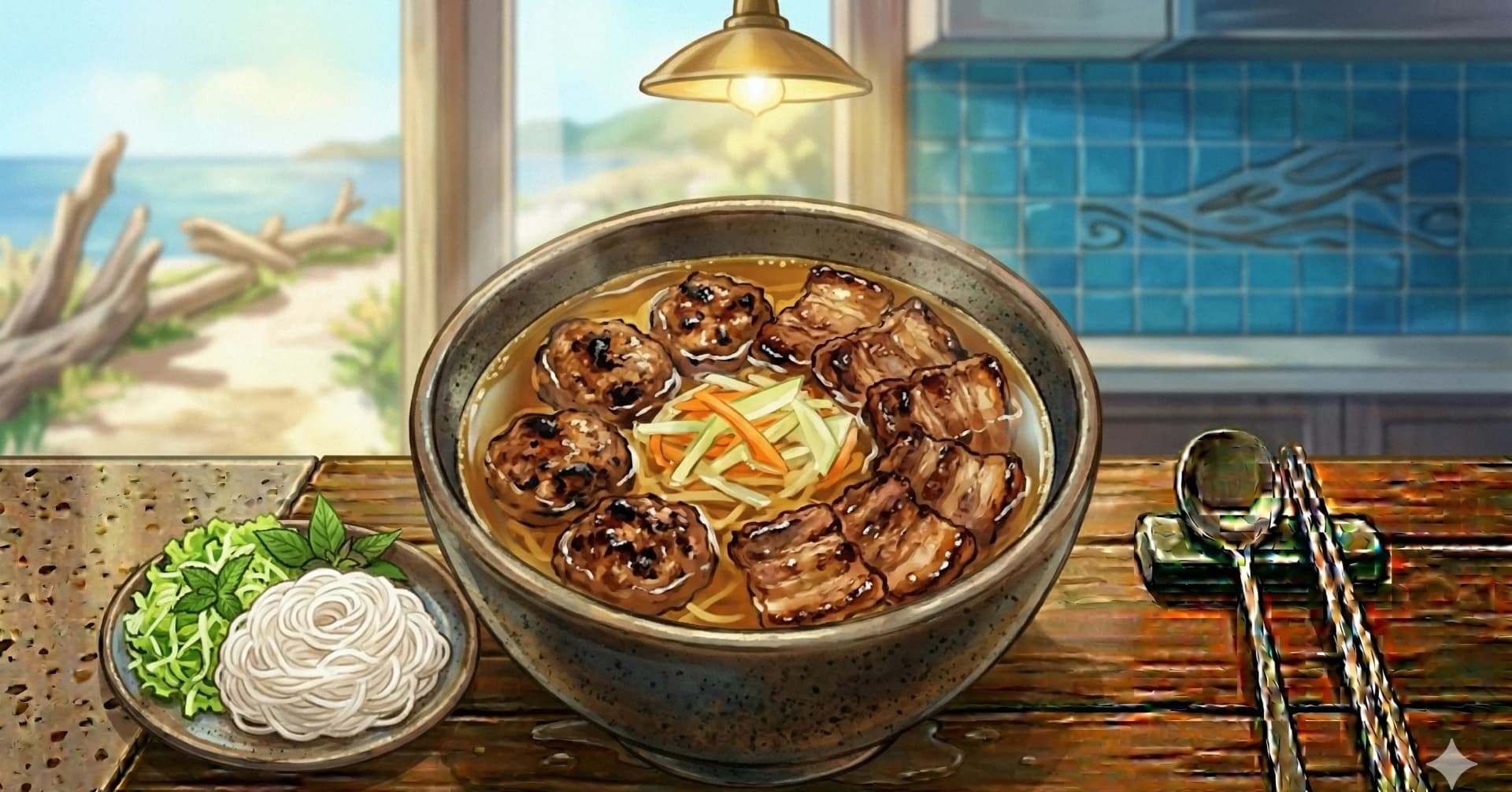
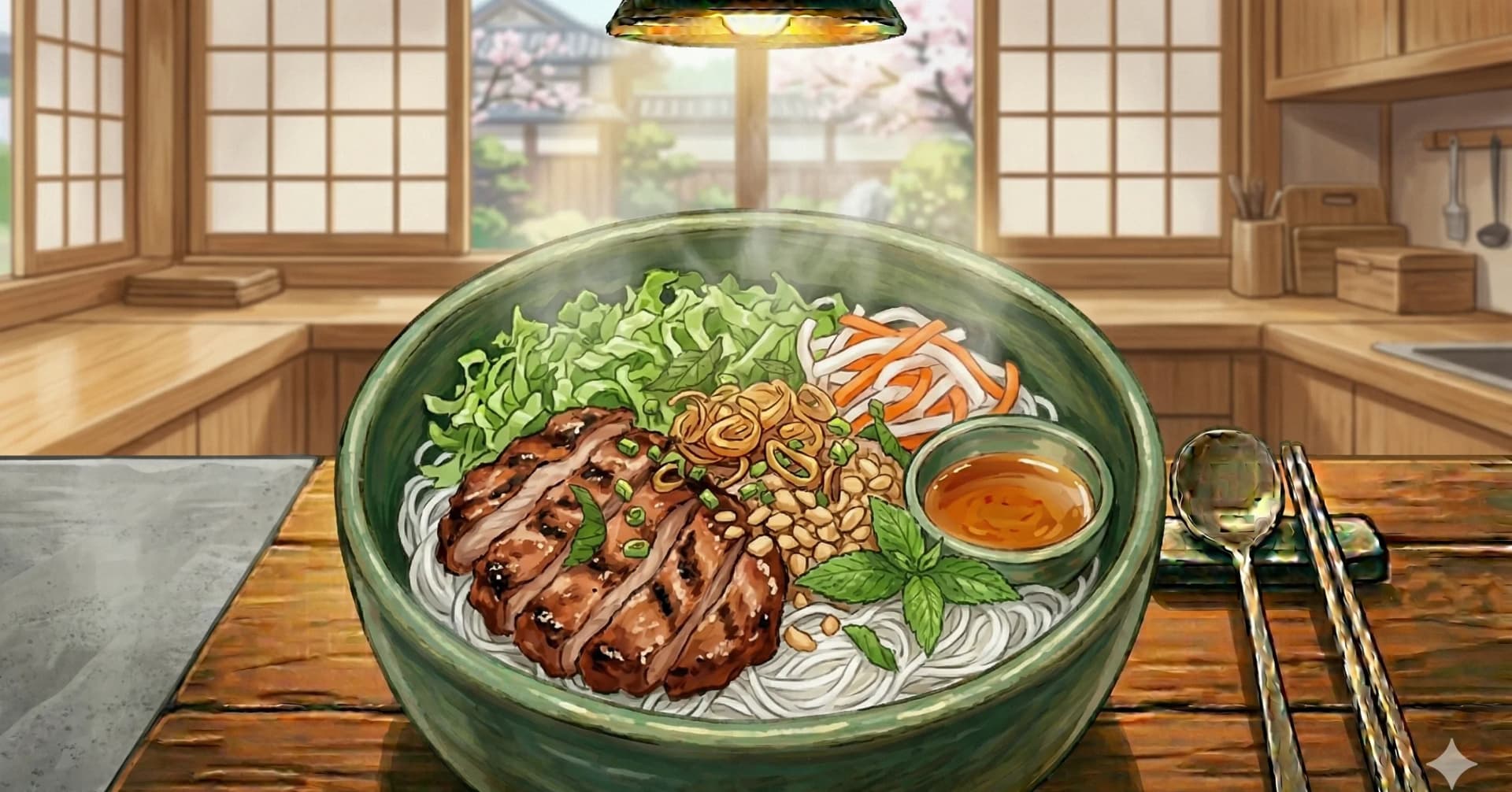
Charred pork patties and belly in a sweet-sour broth, served over cool vermicelli with fresh herbs
Bun cha is a lunchtime dish, and in Hanoi it is eaten at lunchtime with a seriousness that borders on devotion. Walk through the Old Quarter around eleven in the morning and you will find low plastic stools crowded around charcoal grills, the air thick with smoke from caramelizing pork fat. Each table gets the same arrangement: a bowl of warm, sweet-sour broth holding freshly grilled pork patties and slices of caramelized belly, a plate of room-temperature rice vermicelli, and a generous platter of lettuce, herbs, and bean sprouts. You tear a piece of lettuce, lay a few noodles on it, tuck in some herbs and a pork patty, dip the bundle into the broth, and eat it in two bites. The whole thing disappears in about fifteen minutes.
The broth is where bun cha separates itself from other Vietnamese noodle dishes. Unlike the deeply simmered stock behind pho bo, the dipping broth here is a quick preparation, essentially a diluted nuoc cham with warm water, fish sauce, sugar, lime juice, garlic, and chili. It is meant to be light enough that you want to drink the last few spoonfuls after the pork is gone. The pickled green papaya or daikon and carrot that float in the broth add a gentle crunch and a vinegary brightness that cuts through the richness of the grilled meat.
What makes bun cha compelling at home is the contrast it puts on the table. The pork is hot, smoky, and slightly sweet from its caramelized marinade. The noodles are cool. The herbs are sharp and green. The broth is warm and tangy. Nothing about the dish is heavy, even though the main protein is fatty pork. It belongs alongside other Vietnamese dishes built on the same principle of assembled contrast, like goi cuon with its cool rice paper wrappers, or banh xeo with its crispy shell and soft herb filling. Once the components are prepped, the meal comes together quickly, making it a surprisingly practical weeknight dinner.
At a Glance
Yield
4 servings
Prep
40 minutes (plus 30 minutes marinating)
Cook
20 minutes
Total
1 hour 30 minutes
Difficulty
Easy
Ingredients
Pork Patty Ingredients
- 1 lbfatty pork mince (at least 20% fat)
- 2 tbspfish sauce
- 1 tbspoyster sauce
- 2 tbsplight brown sugar or palm sugar
- 1/2 tspfreshly ground black pepper
- 2 tbspfinely minced lemongrass (bottom stalk only, about 1 large stalk)
- 3 clovesgarlic, finely minced
- 1small shallot (about 20 g), finely minced
- 2 tbspfinely chopped green onions
- 1 tsproasted rice powder (optional, see method)
- 1 tspneutral oil for coating hands
Pork Belly Ingredients
- ½ lbskin-off pork belly, sliced 5 mm thick
- 1 tbspfish sauce
- 1 tbspsugar
- 1 clovegarlic, finely minced
- 1/4 tspblack pepper
Dipping Broth Ingredients
- ½ cupwarm water
- ¼ cupgranulated sugar
- ¼ cupfish sauce
- 3 tbspfresh lime juice (about 2 limes)
- 2 tbsprice vinegar
- 4 clovesgarlic, finely minced
- 1to 2 bird's eye chilies, thinly sliced
Pickled Vegetable Ingredients
- 4 ozdaikon radish (about 1½ radishes), cut into thin matchsticks
- 1medium carrot (about 80 g), cut into thin matchsticks
- 1 tspfine sea salt
- 1 tbspgranulated sugar
- 2 tbsprice vinegar
- ¼ cupwarm water
To Serve
- 1 lbdried rice vermicelli noodles (bun)
- 1head butter lettuce or red leaf lettuce, leaves separated
- 5½ ozbean sprouts
- 1 bunchfresh mint
- 1 bunchfresh cilantro
- —Fresh perilla leaves (tia to), if available
- —Fresh Thai basil, if available
- —Lime wedges
- —Sliced bird's eye chili (optional)
Method
- 1
Combine the pork mince with the fish sauce, oyster sauce, brown sugar, black pepper, lemongrass, garlic, shallot, green onions, and roasted rice powder if using. Mix with your hands until the seasonings are evenly distributed but the meat is not overworked. Cover and refrigerate for at least 30 minutes or up to overnight.
- 2
If using pork belly, toss the slices with the fish sauce, sugar, garlic, and black pepper in a separate bowl. Refrigerate alongside the mince.
- 3
Make the pickled vegetables while the meat marinates. Toss the daikon and carrot matchsticks with the salt and let them sit for 15 minutes. They will soften and release liquid. Rinse under cold water, squeeze gently to remove excess moisture, then combine with the sugar, rice vinegar, and warm water. Set aside at room temperature. The pieces should taste lightly tangy and still have a clean crunch after about 20 minutes.
- 4
Prepare the dipping broth. Stir the warm water and sugar together until the sugar dissolves completely. Add the fish sauce, lime juice, rice vinegar, garlic, and sliced chilies. Taste and adjust. It should be a balanced sweet-sour-salty-spicy, leaning slightly sweet. The broth will mellow once the grilled meat and pickled vegetables are added. Set aside.
- 5
Cook the rice vermicelli according to package directions, usually by soaking in boiling water for 3 to 5 minutes until tender but still slightly chewy at the center. Drain, rinse under cold water to stop the cooking and remove excess starch. Shake dry and portion onto individual plates or a serving platter. The noodles should be at room temperature, not hot.
- 6
Oil your hands lightly and shape the pork mixture into roughly 24 small patties, each about 4 cm across and 1 cm thick. They should be slightly flattened rather than round, which increases the surface area for charring.
- 7
Heat a grill, grill pan, or cast-iron skillet over medium-high heat until very hot. If using a grill pan or skillet, brush lightly with oil. Cook the patties in batches without crowding, about 3 minutes on the first side. The edges should look opaque and the undersides should develop dark, caramelized spots. Flip and cook for 2 to 3 minutes more. The surface should be lightly charred in places with a sticky, lacquered appearance from the sugar in the marinade. Transfer to a plate.
- 8
Grill the pork belly slices over the same high heat, about 2 minutes per side, until the edges curl and the fat renders into golden, slightly crispy patches. The sugar in the marinade will cause quick browning, so watch closely and move pieces to a cooler area if they darken too fast.
- 9
Arrange the lettuce leaves, herbs, bean sprouts, and lime wedges on a large platter.
- 10
To serve, divide the dipping broth among individual bowls. Add a few spoonfuls of pickled vegetables with some of their liquid. Place the hot grilled pork patties and belly slices directly into the broth. The pork should sit partly submerged, releasing some of its juices into the liquid.
- 11
Each person takes a piece of lettuce, adds noodles and herbs, tops with a piece of pork, and dips the bundle into the broth bowl. Alternatively, some prefer to add noodles directly to the broth bowl and eat it as a loose soup.
Key Ingredient Benefits
Fish sauce (nuoc mam): The backbone of Vietnamese seasoning. Produced by fermenting small fish, usually anchovies, with salt for months to years. The fermentation process breaks down proteins into free amino acids, particularly glutamic acid, which is responsible for its intensely savory character. A tablespoon provides around 1,400 mg of sodium, so the overall dish is balanced by the unseasoned noodles and raw vegetables. Look for brands with only fish and salt on the label for the cleanest flavor.
Lemongrass: The lower third of the stalk holds the most citral and other aromatic compounds. In Vietnamese traditional medicine, lemongrass is considered cooling and is commonly brewed into a tea believed to aid digestion and reduce fever. Its essential oil has shown antimicrobial properties in laboratory studies, though culinary amounts are modest.
Garlic: Contains allicin when crushed, a sulfur compound that gives raw garlic its pungent bite. Allicin is unstable and largely destroyed by heat, which is why both cooked garlic (in the patties) and raw garlic (in the broth) appear in this dish, contributing different flavor profiles. Garlic has a long history of use in traditional medicine systems across Asia for cardiovascular and immune support.
Rice vermicelli (bun): Made from rice flour and water, these thin noodles are naturally gluten-free. They have a high glycemic index on their own but are moderated in this dish by the protein from pork, the fiber from vegetables, and the acidity from the broth, all of which slow digestion.
Perilla (tia to): A member of the mint family with a distinctive flavor sometimes described as a cross between basil, mint, and anise. It is rich in rosmarinic acid, a polyphenol with antioxidant properties studied in the context of allergic responses and inflammation. In Vietnamese cuisine, perilla appears most often alongside grilled meats and in noodle bowls.
Why This Works
The fat content in the pork mince is not optional. At 20% or higher, the fat keeps the patties juicy through the high heat of grilling and provides the rendered drippings that caramelize on the surface. Lean pork produces dry, crumbly patties that lack the sticky, lacquered exterior that defines good bun cha.
Fish sauce and sugar in the marinade serve a dual purpose. The sugar caramelizes quickly on a hot grill, creating a Maillard-rich crust in a fraction of the time it would take unseasoned meat to brown. The fish sauce provides not just salt but glutamates, which amplify the savory depth of the pork. Oyster sauce reinforces this with additional amino acid complexity.
The lemongrass and shallot contribute aromatic oils that perfume the pork from within, while the garlic caramelizes alongside the sugar on the surface. These aromatics are finely minced rather than pureed so they distribute evenly without releasing too much moisture, which would steam the patties instead of charring them.
The dipping broth works because it is served warm but not hot. The moderate temperature keeps the pork patties from cooling too quickly while allowing the raw garlic and chili to retain their sharpness. The acidity from lime juice and rice vinegar cuts through the pork fat with each bite, resetting the palate and keeping the dish from ever feeling heavy.
Serving the noodles at room temperature, separate from the hot broth, preserves their texture. Rice vermicelli turns mushy in hot liquid within minutes, so the dip-and-eat format protects the noodles while giving each bite a temperature contrast that keeps the meal lively.
Substitutions & Variations
Pork mince: Use a combination of 350 g lean pork mince and 100 g finely diced pork fat or fatty bacon if your mince is too lean. Ground chicken thigh works as a lighter alternative, though the flavor will be milder and you should increase the fish sauce by 1 teaspoon.
Pork belly: If pork belly is unavailable or unwanted, the dish is still excellent with patties alone. Some versions in Hanoi serve only patties, while others include both. Thinly sliced pork shoulder can substitute in a pinch.
Lemongrass: Substitute 2 teaspoons of lemongrass paste from a tube if fresh stalks are unavailable. Add a small strip of lemon zest to the marinade to supplement the citrus notes.
Oyster sauce: Replace with 1 additional tablespoon of fish sauce and 1/2 teaspoon of sugar if you prefer to keep the dish free of oyster-derived ingredients.
Pickled vegetables: Green papaya is the traditional Hanoi choice. If you can find unripe green papaya, peel it, seed it, and shred it into thin strips. Salt, rinse, and pickle the same way as the daikon and carrot.
Roasted rice powder: Toast 2 tablespoons of raw glutinous rice or jasmine rice in a dry skillet over medium heat, stirring constantly, until deep golden and fragrant, about 3 to 4 minutes. Grind to a coarse powder in a mortar or spice grinder. This adds a nutty depth to the patties and is also used in larb.
Coconut soda broth: Some Hanoi-style recipes use coconut soda (nuoc dua) in place of part of the water in the dipping broth. Replace 60 ml of the warm water with coconut soda for a slightly sweeter, rounder broth.
Grilling method: If you lack an outdoor grill, a cast-iron grill pan over high heat works well. An oven broiler set to high, with the patties on a wire rack about 10 cm from the element, will also produce good char in about 4 minutes per side. Air-frying at 200C (400F) for 5 minutes per side is a convenient alternative, though it produces less smokiness.
Serving Suggestions
Bun cha is traditionally a standalone meal, but it pairs naturally with other Vietnamese dishes when you want a larger spread. Start with goi cuon, the fresh spring rolls filled with shrimp, herbs, and vermicelli, which share the same herb-and-noodle foundation and offer a cool, clean opening.
For a more substantial table, add banh xeo, the crispy turmeric-tinged crepes filled with pork and bean sprouts. The textures complement each other well, and both dishes use the same herb platter, so preparation overlaps.
Fried spring rolls (nem ran or cha gio) are the classic Hanoi-style accompaniment. Dip them directly into the bun cha broth before eating, which is the local way and worth trying.
If you are building a Vietnamese dinner around grilled meats, consider ga nuong xa, lemongrass grilled chicken, as a second protein on the same table. The shared lemongrass and fish sauce notes create a cohesive flavor thread across dishes.
A simple dipping plate of Vietnamese chili sauce (tuong ot) alongside the broth gives guests the option to adjust heat to their liking. Iced Vietnamese coffee or a cold bia hoi (draft lager) is the traditional drink pairing.
Storage & Reheating
Pork patties: Store cooked patties in a sealed container in the refrigerator for up to 3 days. Reheat on a hot skillet or grill pan over medium-high heat for about 2 minutes per side, until the exterior crisps again and the interior is warmed through. Microwaving will warm them but softens the charred crust.
Pork belly slices: Store and reheat the same way as the patties. The rendered fat re-crisps nicely in a hot pan.
Dipping broth: Keeps refrigerated for up to 4 days. The garlic flavor will intensify over time. Warm gently before serving, or serve at room temperature. Add a squeeze of fresh lime juice to brighten it after storage.
Pickled vegetables: Keep in their brine in the refrigerator for up to 1 week. They will continue to soften slightly but remain pleasant.
Noodles: Cooked rice vermicelli does not store well. It hardens and clumps in the refrigerator. Cook fresh noodles for each serving. They take only a few minutes, so this is not burdensome.
Freezer: Uncooked marinated patties freeze well. Place them on a parchment-lined tray in a single layer, freeze until solid, then transfer to a zip-top bag. Freeze for up to 1 month. Grill directly from frozen, adding 1 to 2 minutes per side. Cooked patties can also be frozen for up to 1 month and reheated from thawed.
Herb platter: Prepare herbs and lettuce up to a few hours ahead, wrapped loosely in damp paper towels inside a container in the refrigerator. They will stay crisp and fresh.
Cultural Notes
Bún chả is the lunch dish of Hanoi. The city's bún chả restaurants run roughly 11 AM to 2 PM, then close. Outside those hours it is hard to find, and locals will tell you that ordering it for dinner is a mistake. The dish jumped into global recognition in 2016 when then-US President Barack Obama sat down to a bowl of bún chả with Anthony Bourdain at Bún Chả Hương Liên in Hanoi. The episode aired on Bourdain's Parts Unknown, and there was a measurable spike in international Vietnamese restaurant openings featuring the dish in the months that followed.
The dish belongs to the northern Vietnamese tradition, which is less sweet and more austerely balanced than the southern cooking of Saigon. The defining structure of bún chả is the way the components arrive separately and only become a meal at the table. Grilled pork in one bowl. Cold rice vermicelli in another. A pile of fresh herbs. A warm sweet-sour dipping broth that ties everything together. Each diner builds each bite to their own preference, dipping noodles and pork into the broth in whatever ratio works for them. The DIY assembly logic shows up in bánh xèo, gỏi cuốn, and bún thịt nướng. It is one of the deeper features of Vietnamese eating culture.
The pork is the heart of the dish, and there are two preparations. Chả băm is minced pork shaped into small patties. Chả miếng is pork belly cut into slices. Both go onto charcoal grills until deeply caramelized. The smoky char is one of the dish's defining sensory features and is hard to replicate over gas. Once cooked, the pork gets submerged in the dipping broth, where fish sauce, lime juice, sugar, garlic, chilies, and pickled green papaya combine into a complex sweet-sour-savory-smoky liquid. That broth is what turns "grilled pork over noodles" into bún chả.
The most famous Hanoi shops (Bún Chả Hương Liên, Bún Chả Đắc Kim, Bún Chả Tuyết) have been operating continuously for decades. They remain pilgrimage sites for visiting food enthusiasts, and the lunch rush still moves at a pace that does not slow down for tourists.
Nutrition Facts
Calories: 480kcal (24%)|Total Carbohydrates: 52g (19%)|Protein: 29g (58%)|Total Fat: 28g (36%)|Saturated Fat: 10g (50%)|Cholesterol: 126mg (42%)|Sodium: 1450mg (63%)|Dietary Fiber: 1.5g (5%)|Total Sugars: 15g
You Might Also Like
Ratings & Comments
Ratings & Comments
Ratings
Share your thoughts on this recipe.
Sign in to rate and comment