Cross-Cultural · Korea
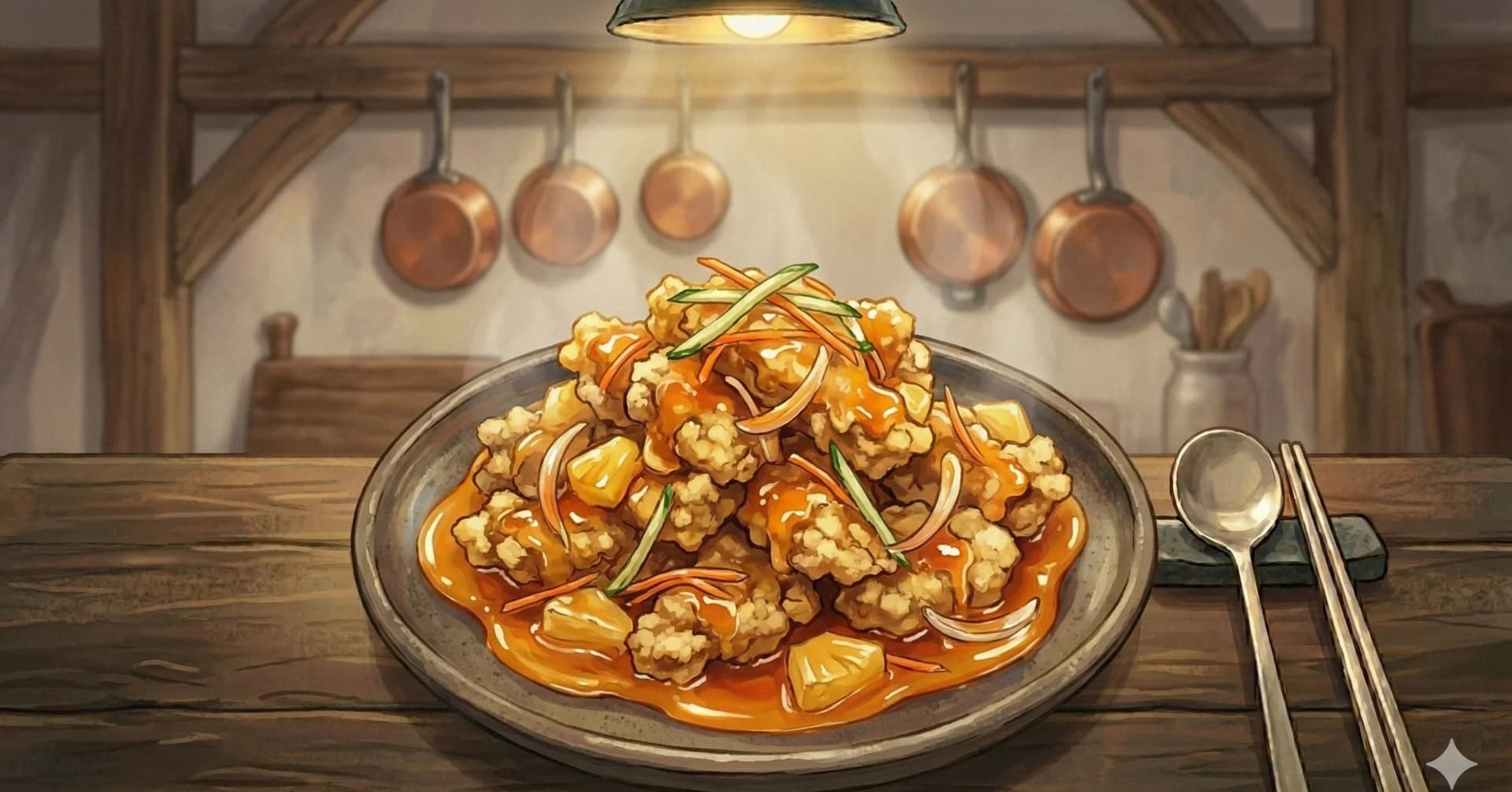
Sweet & Sour Pork (Tangsuyuk / 탕수육)
Double-fried pork in a solidified potato starch batter with a bright sweet and sour sauce of pineapple, vegetables, and vinegar
Tangsuyuk is Korean sweet and sour pork, and the secret to its impossibly crispy batter is a technique you will not find in Western cooking: soaking potato starch in water for an hour and a half until the starch sinks and solidifies at the bottom of the bowl, then draining the water and using only the dense, solidified starch to coat the pork. This concentrated starch creates a batter that fries into a shell so crispy it shatters when you bite through it.
The pork is sliced into thin strips, seasoned with salt, pepper, and ginger, then coated in the solidified starch with a bit of egg white to bind. It fries twice: the first pass at 330°F cooks the pork through and sets the coating, the second pass crisps the coating into glass. The double fry is what gives tangsuyuk its reputation. Single-fried versions go soggy in minutes. Double-fried tangsuyuk stays crispy long enough to survive the sauce.
The sweet and sour sauce is bright and fruity: water, sugar, vinegar, and a touch of soy sauce thickened with a starch slurry, with onion, carrot, bell pepper, and pineapple chunks cooked in. It gets poured over the fried pork at the table, or served on the side for dipping. Koreans actually debate which method is correct: "bumeok" (pour it over) or "jjikmeok" (dip in it). Both are valid. The argument is part of the fun.
At a Glance
Yield
2 servings
Prep
1 hour 30 minutes
Cook
25 minutes
Total
2 hours
Difficulty
Medium
Ingredients
Pork Ingredients
- 7 ozpork loin, cut into thin 2-3 inch strips
- 1/2 tspsalt
- —ground black pepper, pinch
- —fresh ginger, small piece, minced
- 1egg white
- 1 cuppotato starch, soaked in 3 cups water 1.5 hours, drained, use solidified starch
- 4 cupscooking oil, for frying
Sauce Ingredients
- 3 cupswater
- 1/4 cupsugar
- 4 tbspwhite or rice vinegar
- 1 tbspsoy sauce
- 1 tspsalt
- 2 tbsppotato starch, mixed with 2 tbsp water for slurry
Stir-Fry Ingredients
- 1/2 cupwood ear mushrooms, dried, soaked in warm water 30 min until pliable, drained and torn into bite-sized pieces
- 1/4onion, cut into pieces
- 1 ozcarrot, cut into pieces
- 1/2green bell pepper, cut into pieces
- 2slices canned pineapple, cut into pieces
Method
- 1
Soak 1 cup potato starch in 3 cups water for 1.5 hours — the starch will sink and solidify; drain off the clear water on top. At the same time, soak the dried wood ear mushrooms in warm water for 30 minutes until pliable, then drain and tear into bite-sized pieces.
- 2
Mix the egg white into the solidified potato starch until smooth. Season the pork with salt, pepper, and minced ginger, and pat dry. Add the pork to the egg white and starch mixture, toss, and massage with your hands to coat every piece thoroughly.
- 3
First fry at 160°C (320°F) for 3 minutes — this lower temperature cooks the pork through and sets a pale crust. Gently separate any stuck pieces with chopsticks. Lift out and drain for 1 minute.
- 4
Raise the oil to 180°C (355°F) for the second fry. Fry for 3 to 4 minutes until very crispy and deep golden — the higher temperature is what creates the shattering crust. Drain on a rack.
- 5
Stir-fry the vegetables. Heat a tablespoon of oil in a wok over high heat. Add the onion, carrot, bell pepper, and wood ear mushrooms. Stir-fry for 1 to 2 minutes until crisp-tender. Transfer to a plate.
- 6
Make the sauce. In the same wok, combine water, sugar, vinegar, soy sauce, and salt. Bring to a gentle boil over low heat. Stir the starch slurry, pour it in, and cook for about 1 minute until the sauce turns glossy and thickens. Once the sauce is made, add the pineapple and the stir-fried vegetables, and toss to coat.
- 7
Pour the sauce over the fried pork ("bumeok" style) or serve the sauce on the side for dipping ("jjikmeok" style).
Key Ingredient Benefits
Pork loin: A lean cut chosen specifically for its mild flavor and texture, which lets the crust and sauce dominate. Pork loin is high in protein and B vitamins (especially thiamine), and the leanness keeps the dish from feeling heavy despite the deep frying.
Potato starch: The hero of the dish. Almost pure amylopectin, the branched starch molecule that produces a lighter, glassier crust than cornstarch or wheat flour. The technique of soaking potato starch in water and using only the solidified bottom layer (called appurin) is unique to Korean-Chinese cooking and produces an extraordinarily crisp, chewy batter you cannot achieve with dry starch alone.
Wood ear mushrooms: A textural ingredient more than a flavor one. Their gelatinous, slightly crunchy bite contrasts beautifully with the soft pineapple and crisp pork. Wood ear is one of the most popular fungi in Chinese-Korean cooking and contributes soluble fiber and trace minerals.
Pineapple: The traditional sweet-acidic counterweight to the spicy-sweet sauce. Fresh pineapple contains bromelain, an enzyme that can tenderize meat, but the canned version called for here has its bromelain deactivated by heat. The pineapple is purely about flavor and color.
Rice vinegar: Mild and clean, with less harshness than white vinegar. The vinegar's acidity is essential for cutting through the richness of the fried pork and the sweetness of the sauce.
Why This Works
Soaking potato starch in water for 90 minutes is what gives tangsuyuk its impossibly crisp texture. As the starch sits, the granules absorb water and settle at the bottom of the bowl as a dense, hydrated paste. This wet starch behaves completely differently from dry starch in oil — the moisture in the paste flashes to steam on contact with hot oil, puffing the coating outward and creating microscopic air pockets that produce the signature shattering crust. Mixing the egg white into the solidified starch first, then tossing with the pork, gives an even more uniform coating than the older technique of starch-then-egg-white.
The double fry is the second half of the equation. The first fry, at a moderate 160°C, cooks the pork through and sets a pale crust. The second fry, at a higher 180°C, sets the crust and dehydrates the surface, producing a crunch that holds even when the sauce hits it. The same principle drives yangnyeom chicken, karaage, and kkanpunggi.
Stir-frying the vegetables before making the sauce keeps them crisp-tender. If you add raw vegetables to the simmering sauce, they overcook and the bell pepper turns army green. By cooking them separately and adding them at the end, they retain bright color and a fresh bite.
The sauce reaches its glossy, glaze-like consistency through the addition of a potato starch slurry, not by long reduction. The slurry produces a clear, shiny, almost translucent finish that coats the pork without weighing it down. Adding the pineapple after the sauce thickens preserves the fruit's texture and prevents it from breaking down into mush.
Substitutions & Variations
Pork loin: Pork tenderloin works perfectly. Boneless chicken thigh or beef sirloin can substitute for variations called tangsuyuk with chicken or beef in many Korean-Chinese restaurants.
Potato starch: Cornstarch is the most common substitute and produces a perfectly good crust, just slightly less glassy and crunchy. Tapioca starch produces a crackly crust but tends to soften faster. Wheat flour will not produce the right texture and is not recommended.
Wood ear mushrooms: Soaked dried shiitake or fresh mushrooms work for flavor but lose the textural contribution. Skipping them entirely is acceptable; the dish will be slightly less interesting but still very good.
Pineapple: Fresh works but choose ripe, sweet pineapple. Mandarin orange segments are a regional Korean variation, especially in Daegu and the southeast. Lychee or even canned mango can substitute for a different fruit profile.
Rice vinegar: White vinegar plus a pinch of sugar approximates the milder profile of rice vinegar. Apple cider vinegar will work but adds an apple note. Avoid balsamic or red wine vinegar entirely.
Serving Suggestions
Tangsuyuk is meant for sharing, served alongside other Korean-Chinese classics. The classic combination is tangsuyuk plus jjajangmyeon (black bean noodles) or jjamppong (spicy seafood noodle soup), what Koreans call a set menu at Han-Jung restaurants. Many people order all three for a celebratory meal.
The dish comes in two serving styles. Bumeok style means the sauce is poured over the fried pork, soaking it slightly. Jjikmeok style means the sauce is served on the side for dipping, keeping the pork at maximum crispness. The choice between them is one of the most heated debates in Korean food culture; both are correct, depending on personal preference.
For a complete meal, serve with steamed short-grain rice, a small dish of kimchi, and pickled radish (mu). A bottle of cold beer is the canonical pairing.
Storage & Reheating
Refrigerator: Store fried pork and sauce separately in airtight containers for up to 3 days. Combining them before storing leads to soggy pork and a thinned-out sauce.
Reheating the pork: Oven or air fryer is essential. Spread the pork in a single layer on a rack-lined baking sheet and reheat at 200°C (400°F) for 6 to 8 minutes, or in an air fryer at the same temperature for 4 to 5 minutes. Microwave will turn the crust limp and pasty.
Reheating the sauce: Warm in a small saucepan over medium heat with a splash of water to loosen. The starch may need a quick whisk to re-emulsify.
Make-ahead: The sauce base (water, sugar, vinegar, soy sauce, salt) can be made up to 3 days in advance. The starch slurry should be added fresh at reheating time. The pork is best fried just before serving but can be held in a 90°C (200°F) oven on a rack for up to 30 minutes if needed.
Freezing: Not recommended. Both the crust and the sauce suffer significantly.
Cultural Notes
Tangsuyuk is the most famous dish of Korea's Han-Jung (한중) cuisine — Chinese-Korean food developed by the Chinese diaspora that settled in Korea in the late 1800s, primarily in Incheon, where the country's original Chinatown still stands. The dish is a Koreanized adaptation of the Chinese gulu yuk (咕咾肉), itself a Cantonese take on Western-influenced sweet and sour pork.
What makes tangsuyuk distinctly Korean is the technique. The hydrated potato starch coating, the sauce-on-the-side serving option, and the use of pineapple alongside vegetables in a clear sweet-vinegar sauce all developed in Korea, not China. The Cantonese original uses a thinner batter, a thicker tomato-based sauce, and is generally redder and stickier. Tangsuyuk's translucent, glassy sauce and shattering crust represent a separate culinary lineage that has now been refined for over a century.
The dish has become so culturally entrenched that "bumeok or jjikmeok?" — pour the sauce or dip in the sauce — has become Korean shorthand for any decisive personal preference question, similar to "Mac or PC?" in English. Both styles are correct and both have passionate defenders. The dish is also one of the most common delivery foods in Korea, with most Han-Jung restaurants offering it in family-sized portions designed for sharing.
Nutrition Facts
Calories: 517kcal (26%)|Total Carbohydrates: 66.2g (24%)|Protein: 25.8g (52%)|Total Fat: 16.3g (21%)|Saturated Fat: 4.5g (23%)|Cholesterol: 97mg (32%)|Sodium: 685mg (30%)|Dietary Fiber: 1.1g (4%)|Total Sugars: 28.4g
You Might Also Like
Ratings & Comments
Ratings & Comments
Ratings
Share your thoughts on this recipe.
Sign in to rate and comment