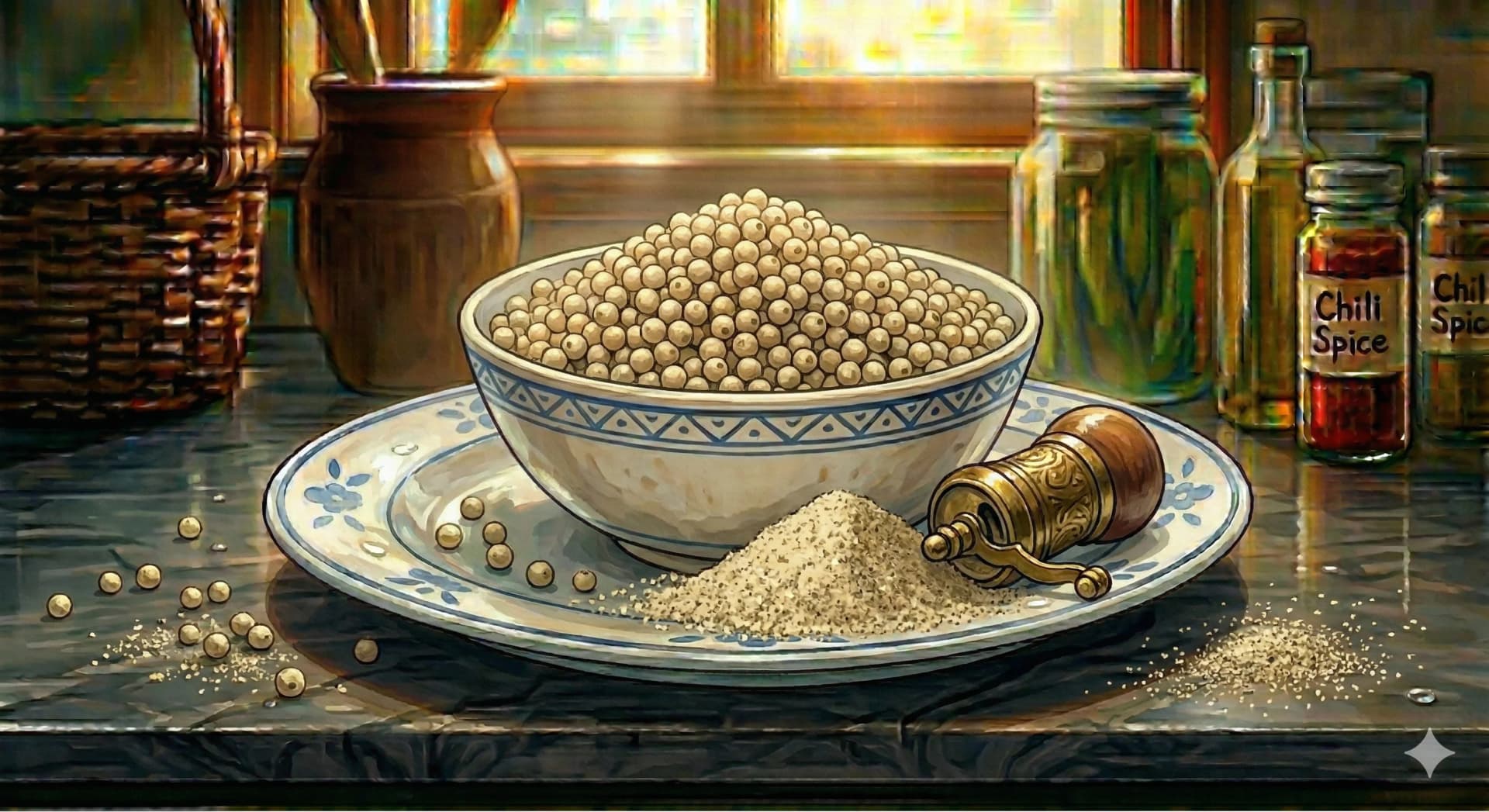
White Pepper
Also known as: Bai Hu Jiao, White Peppercorn, Piper nigrum (white processed)
White pepper is black pepper with the outer hull removed, revealing the inner seed. It has a sharper, more purely hot flavor than black pepper — less aromatic but more penetrating, with a slightly fermented, earthy quality from the soaking process used to remove the hull.
In Chinese cooking, white pepper is often preferred over black: its heat is cleaner and less herbal, and it does not create visible black flecks in pale soups and egg dishes.
Key facts at a glance:
- Black pepper with outer hull removed — revealing the inner seed
- Sharper, more penetrating heat — less aromatic but cleaner than black pepper
- Preferred over black pepper in Chinese cooking — no visible flecks in pale dishes
- Contains piperine — the same bioavailability-enhancing compound found in black pepper
- Most prized from Sarawak — Malaysian Borneo produces the finest for Chinese cooking
Flavor Profile
Origin
South India (origin), Sarawak, Malaysia, Southern China, Southeast Asia
Traditional Medicine Perspectives
Traditional Chinese Medicine
White pepper (Bai Hu Jiao) shares the TCM classification of black pepper — hot, acrid, and warming to the Stomach and large Intestine. It is used to dispel cold, warm the middle burner, and descend rebellious Qi. White pepper is considered slightly more penetrating than black pepper in some TCM traditions, making it appropriate for conditions of interior cold with more severe digestive symptoms.
Modern Scientific Research
White pepper contains piperine, the same bioavailability-enhancing compound found in black pepper.
Research on piperine consistently shows its ability to inhibit the metabolic breakdown of various compounds, increasing their bioavailability.
Like black pepper, white pepper shows antioxidant and anti-inflammatory properties. The processing to produce white pepper reduces some aromatic compounds while retaining the active piperine.
Cultural History
White pepper has been used in Chinese cooking for centuries and is deeply embedded in specific regional preparations. The classic Cantonese pepper and salt seasoning uses white pepper.
Hot and sour soup depends on white pepper for its characteristic heat. In Teochew, Hokkien, and Singaporean Chinese cooking, white pepper is so central that black pepper is rarely used at all.
The most prized white pepper for Chinese cooking comes from Sarawak in Malaysian Borneo, though domestic Chinese production is also significant.
Culinary Uses
Use in soups, particularly where visible black flecks would be undesirable: hot and sour soup, egg drop soup, white-cooked chicken broth, congee, and fish preparations.
Essential in Cantonese pepper salt seasoning for fried seafood and tofu.
Use in dumpling fillings for clean heat without aromatic distraction. Sprinkle over congee just before eating.
Preparation Methods
Grind fresh from whole peppercorns for best flavor. White pepper loses its heat quickly once ground — buy whole and grind as needed.
The flavor is most potent when added at the end of cooking rather than the beginning.
Traditional Dishes
Recipes Using White Pepper
- Niu Rou Yang Cong Jiaozi (Beef and Onion Dumplings)
- Bok Choy in Ginger Sauce (姜汁白菜)
- Beef Brisket Soup (清湯牛腩)
- Char Siu (Chinese BBQ Pork)
- Chicken Chow Mein (鷄肉炒麵)
- La Zi Ji (Chongqing Spicy Chicken)
- Guo Tie (Potstickers)
- Ginger Scallion Beef
- Jiao Hua Ji (Beggar's Chicken)
- Xia Ren Chao Dan (Stir-Fried Shrimp with Eggs)
- Salt and Pepper Squid (椒鹽鮮魷)
- Char Kway Teow (炒粿條)
- Jiu Cai He Zi (Chive Pancakes)
- Five-Spice Roast Chicken
- Sheng Jian Bao (Pan-Fried Soup Dumplings)
- Clams in Black Bean Sauce (豉汁炒蜆)
- Beef with Oyster Sauce (蠔油牛肉)
- Bitter Melon with Egg
- Chinese Stuffed Eggplant (釀茄子)
- Chinese Stuffed Peppers (釀辣椒)
- Jiao Yan Xia (Salt and Pepper Shrimp)
- Har Gow (Crystal Shrimp Dumplings)
- Shrimp and Broccoli in Brown Sauce (虾仁西兰花)
- Siu Yuk (Cantonese Crispy Pork Belly)
- Jakarta Creamy Beef Soup (Soto Betawi)
- Steamed Fish with Ginger and Scallion (薑蔥蒸魚)
- Chinese Steamed Eggs (蒸蛋)
- Sesame Beef (芝麻牛肉)
- Xia Ren Chao Fan (Shrimp Fried Rice)
- Shi Zi Tou (Lion's Head Meatballs)
- Sizzling Rice Soup (鍋巴湯)
- Gong Bao Ji Ding (Kung Pao Chicken)
- Parsi Chicken with Potato Straws (Salli Murgi)
- Yangzhou Chao Fan (Yangzhou Fried Rice)
- Shui Zhu Yu (Sichuan Boiled Fish)
- Bao Zai Fan (Claypot Rice)
- Jiaozi (Pork and Chive Dumplings)
- Hokkien Mee (福建面)
Comments
Share your thoughts on this ingredient.
Sign in to comment0 Comments